Leadership
Guiding a group towards a goal
High score: You step up when a group needs direction and help others get clear about what to do.
Low score: You wait for others to take charge, or take charge without involving the group.
Soft skills is a vague phrase. This free self-assessment turns it into five concrete areas, leadership, teamwork and social skills, adaptability, ownership and problem solving, and shows which one to build first.
Self-rating tool for reflection. It is not a clinical, hiring or selection test.

One test shows one side of you. Each full assessment combines interests, aptitude, thinking style, learning style and role or stream fit into a single report. Pick the one for your stage.
There are no right answers on the statements, so think of your usual pattern, not your best day. In the situations, pick what you would really do, not what sounds best.
Soft skills are shown in different places at each stage, so your report adjusts the advice to match.
These are areas that team leads and managers often mention when they describe a good colleague. Each one is written as everyday behaviour you can rate honestly, whether you are in school, college or a job.
Guiding a group towards a goal
High score: You step up when a group needs direction and help others get clear about what to do.
Low score: You wait for others to take charge, or take charge without involving the group.
Working with and relating to others
High score: You get along with different kinds of people, share credit and make others feel included.
Low score: You prefer to work alone, find it hard to read or connect with others, or end up in repeated friction.
Coping with change and learning new things
High score: You adjust quickly when plans change and are comfortable learning something new.
Low score: Change makes you stressed or resistant, and you prefer to stick to what you already know.
Finishing what you start and being dependable
High score: People can count on you to deliver on time and to tell them early if something will slip.
Low score: You often miss deadlines, wait to be reminded, or only tell people about problems when it is too late.
Working out what to do when things are unclear
High score: You break an unclear problem into parts, try options and learn from what happens.
Low score: You get stuck when no one gives clear instructions or you wait for the answer from someone else.
Each statement describes something you do, such as telling people early about a delay or asking a quieter person for their view. That makes these skills trainable. A lower score means a habit you have not practised yet, not a fixed trait.
Leadership, teamwork and social skills, adaptability, ownership and problem solving are habits that show up in almost every kind of work, from an office or a hospital to a shop or a family business. Technical skill covers the task itself, and these habits shape how well you work with other people on it.
If you are early in your career, ownership and problem solving are often the easiest to practise and the most visible to a manager. If you are moving into a lead role, leadership and teamwork may be the better place to start.
A score on its own convinces no one. Pick your strongest area and write down two real examples, each in three lines: what the situation was, what you did and what changed. Pick your lowest area and run the two-week plan. Examples from real projects, clubs, jobs or family responsibilities are something you can describe to an interviewer, a teacher or a manager.
It is a way to rate your own everyday behaviour with other people and at work, such as working in a group, adapting to change, finishing what you promised and solving problems. This one covers five areas and gives a score for each from your own ratings.
Yes. You can answer the questions, see your five scores and download the report without paying anything.
Partly. Leadership is one of the five areas, with statements and situations on guiding a group, setting a clear goal and asking for feedback. For a deeper look at leadership alone, use the separate leadership self-assessment linked below.
In part. The teamwork and social skills area covers starting conversations, including everyone in a group, sharing credit and disagreeing without making it personal. It is not a clinical measure of social skills.
It covers the people and work-habit skills that are often called employability skills, but it does not test technical knowledge. Pair it with a skills check for your own field.
Yes. The statements are about everyday behaviour in groups, projects, college and work, so they apply whether you are in school, college, looking for a first job or already working. Your report adjusts the situations and advice to the stage you choose.
Take your lowest area and follow its two-week plan, because soft skills improve through small repeated habits and not through reading about them. Take one real responsibility, such as leading a small task or closing every task with a short message, and ask two people for feedback after two weeks.
There is no pass mark. Scores are only against your own answers, so the useful reading is which of your five areas is lowest and which is highest. Retake after a few weeks of practice and compare with your own earlier result.
Statements are rated from 1 to 5 and the ones worded in the negative are reversed. In the situation questions, each option carries a score from 0 to 100. Each area score is the average of its statements and situations, shown out of 100, and the overall score is the average of the five areas.
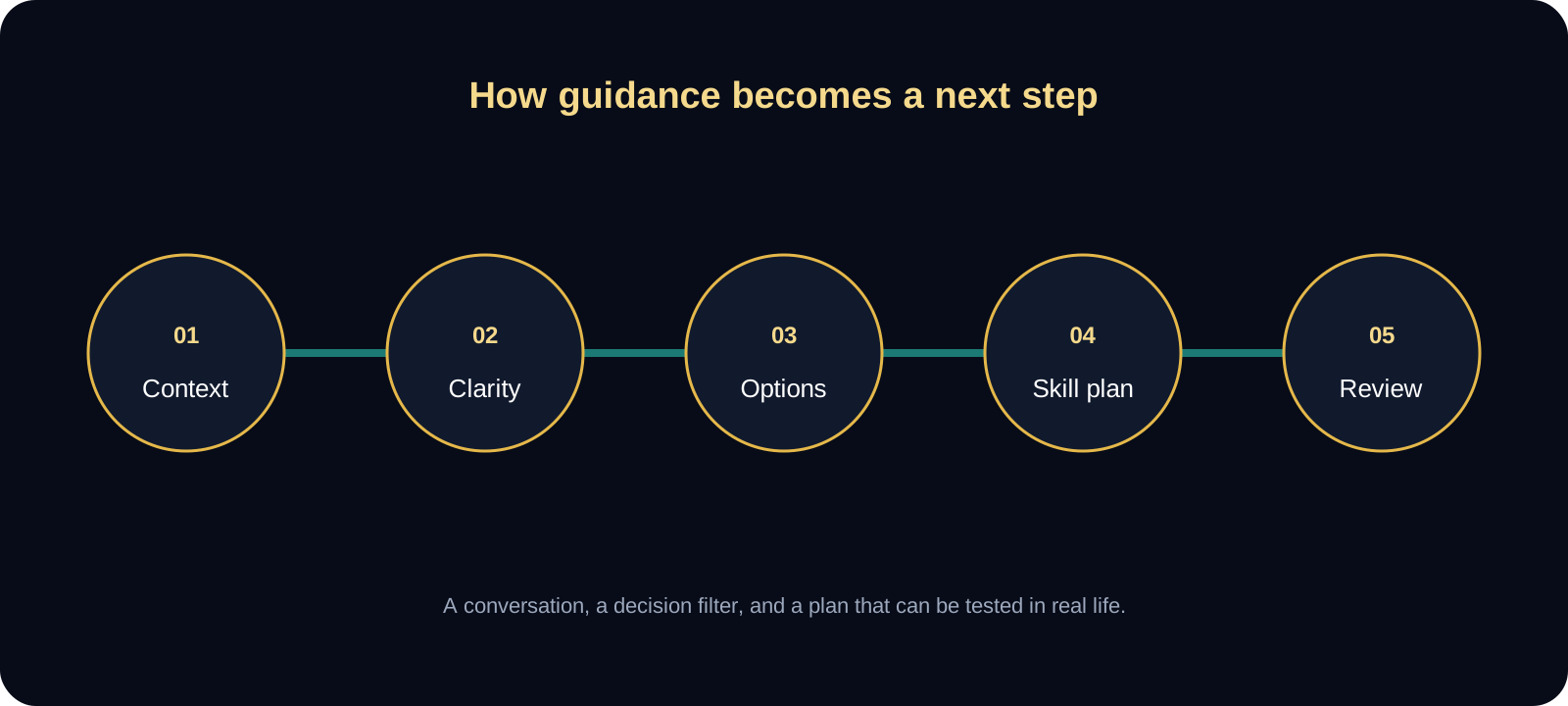
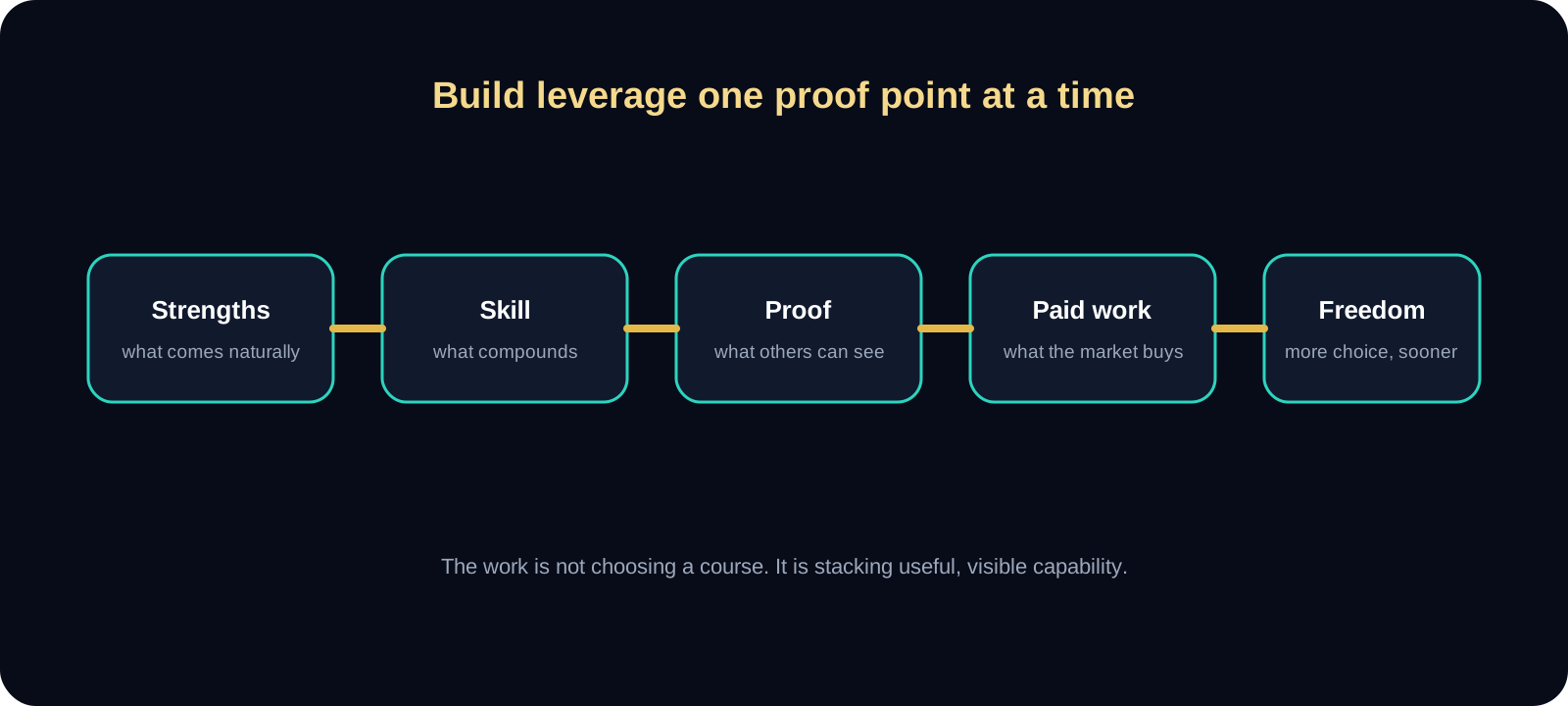
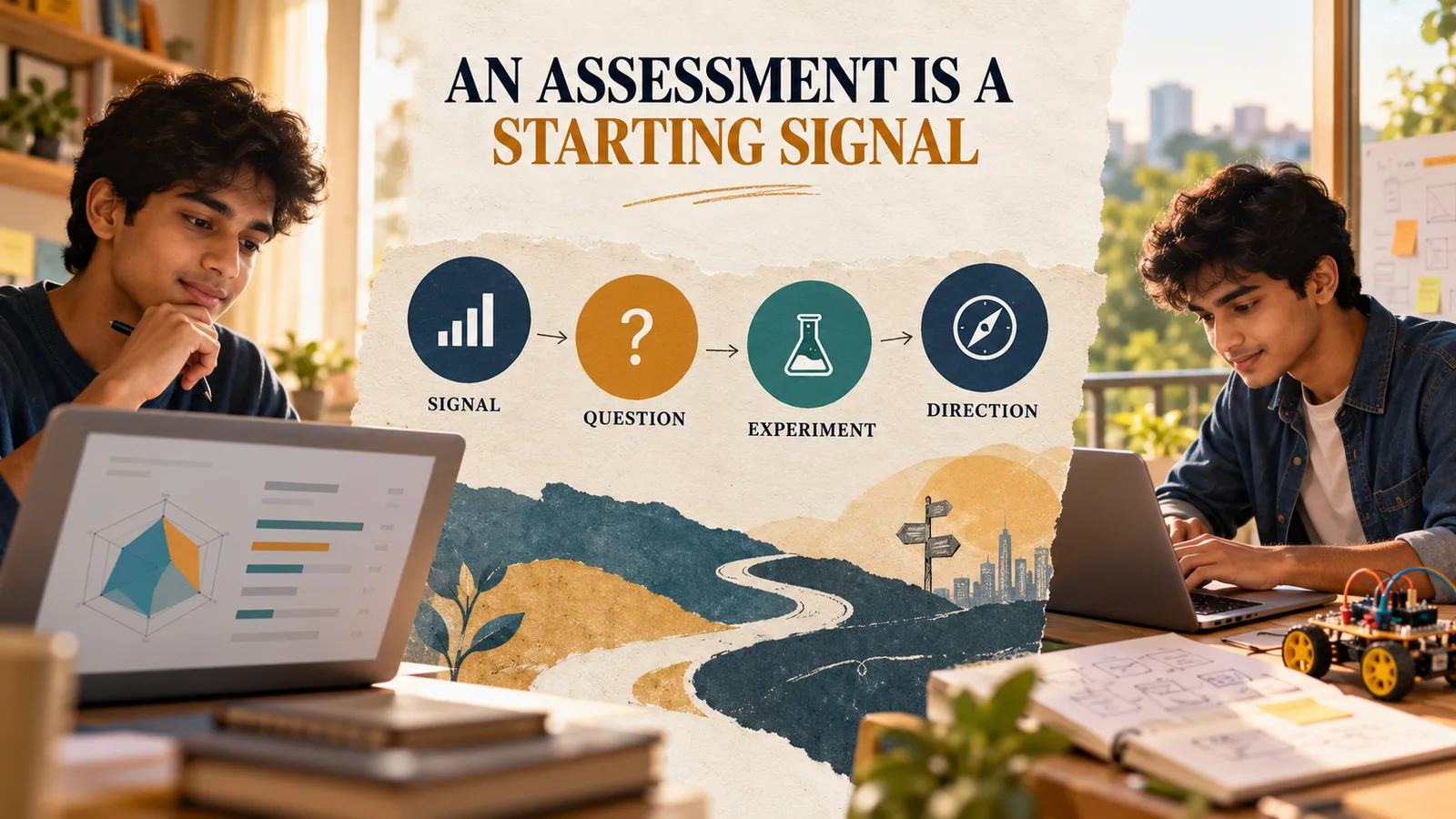
Start with the free test that fits your stage. When the decision gets serious, move to updated career guidance that turns those signals into better choices, stronger skills, and higher leverage.
Use free results to narrow the problem before you commit to a bigger decision.
Use guidance to avoid wasted years, wasted money, and low-value skill choices.
Use the right plan for your stage to turn the result into a practical next step.
Sessions are online across India. The stronger plan gets built inside the guidance service.
Practical student career guidance before the wrong path wastes years, money, and future readiness.
A low-friction first step before the wrong path costs more time and money.
Online across India
Wrong streams, outdated degrees, and low-value skills that waste years and money.
Useful skills, future readiness, and a clearer next decision.
Includes the 1-on-1 and up to 24 small-group sessions across the year.
Real student growth comes from a series of better decisions. This path keeps skill choices, future readiness, and review points visible across the year.
For professionals who need clearer pivots, stronger compensation, and higher-leverage career moves.
Book one sharp 1-on-1 before stagnation, weak positioning, or a bad pivot gets more expensive.
Online across India
Salary ceilings, random upskilling, weak positioning, and pivots that waste time and money.
More useful skills, sharper positioning, and clearer next moves.
AI pressure, stagnation, career pivots, and deciding which next skill move can multiply leverage.
One test shows one side of you. Each full assessment combines interests, aptitude, thinking style, learning style and role or stream fit into a single report. Pick the one for your stage.