Setbacks, effort and learning in one report

Resilience and Growth Mindset Assessment

Low marks, backlogs, rejections, layoffs and long plateaus test everyone. This free self-assessment turns resilience and a growth mindset into five concrete areas, bouncing back, belief that ability can grow, staying with hard tasks, using feedback and mistakes, and drive over time, and shows which one to build first.

40questions
5areas
FreePDF report
Want more than one result? Take the full free career assessment for your stage: 6 tests in one report →

Self-rating tool for reflection. It is not a clinical, hiring or selection test.

A student taking an online career assessment on a tablet
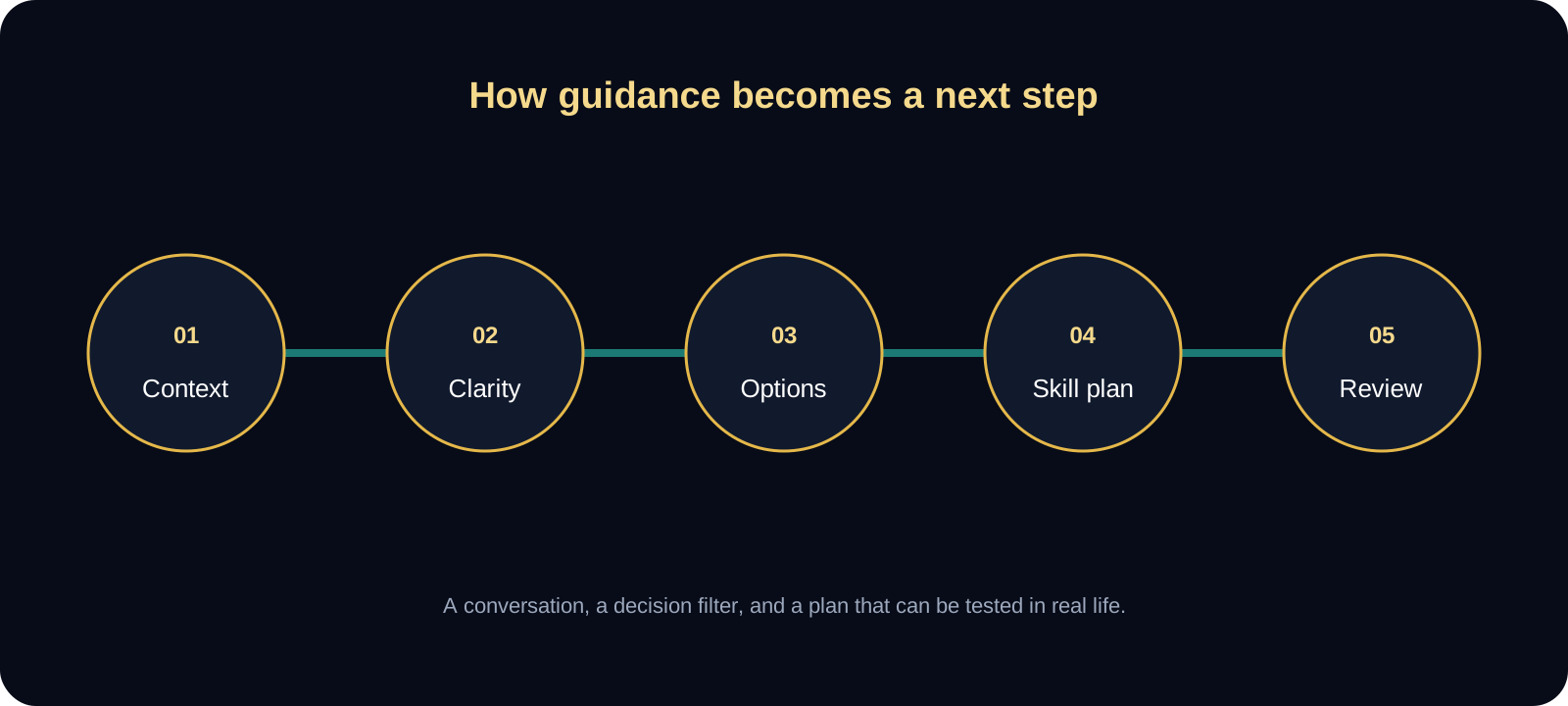
Five-stage career guidance session flow from context to review
A guidance session moves from context to clarity, options, a skill plan and review.
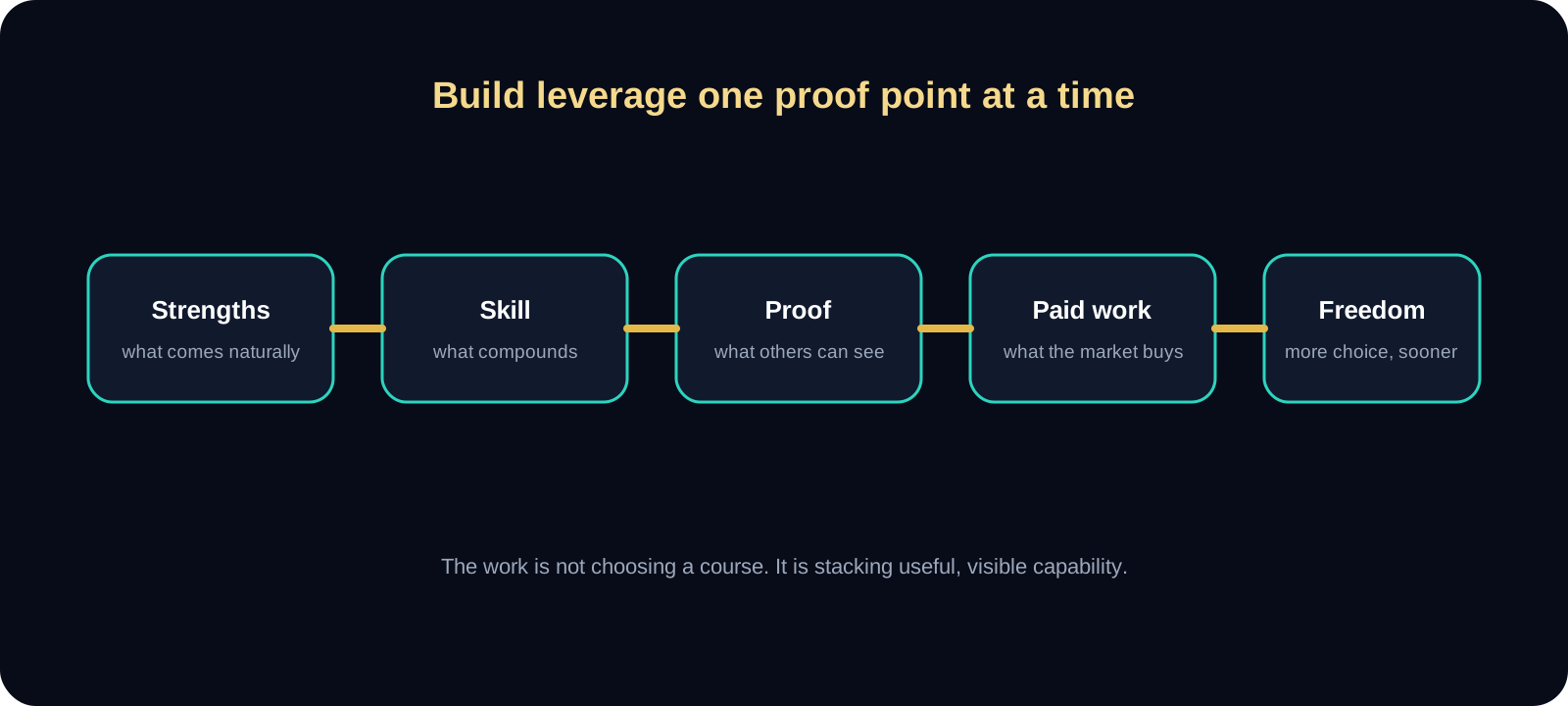
Skill portfolio chain from strengths to financial freedom
Strengths become skills, skills become visible proof, and proof leads to paid work and more freedom.
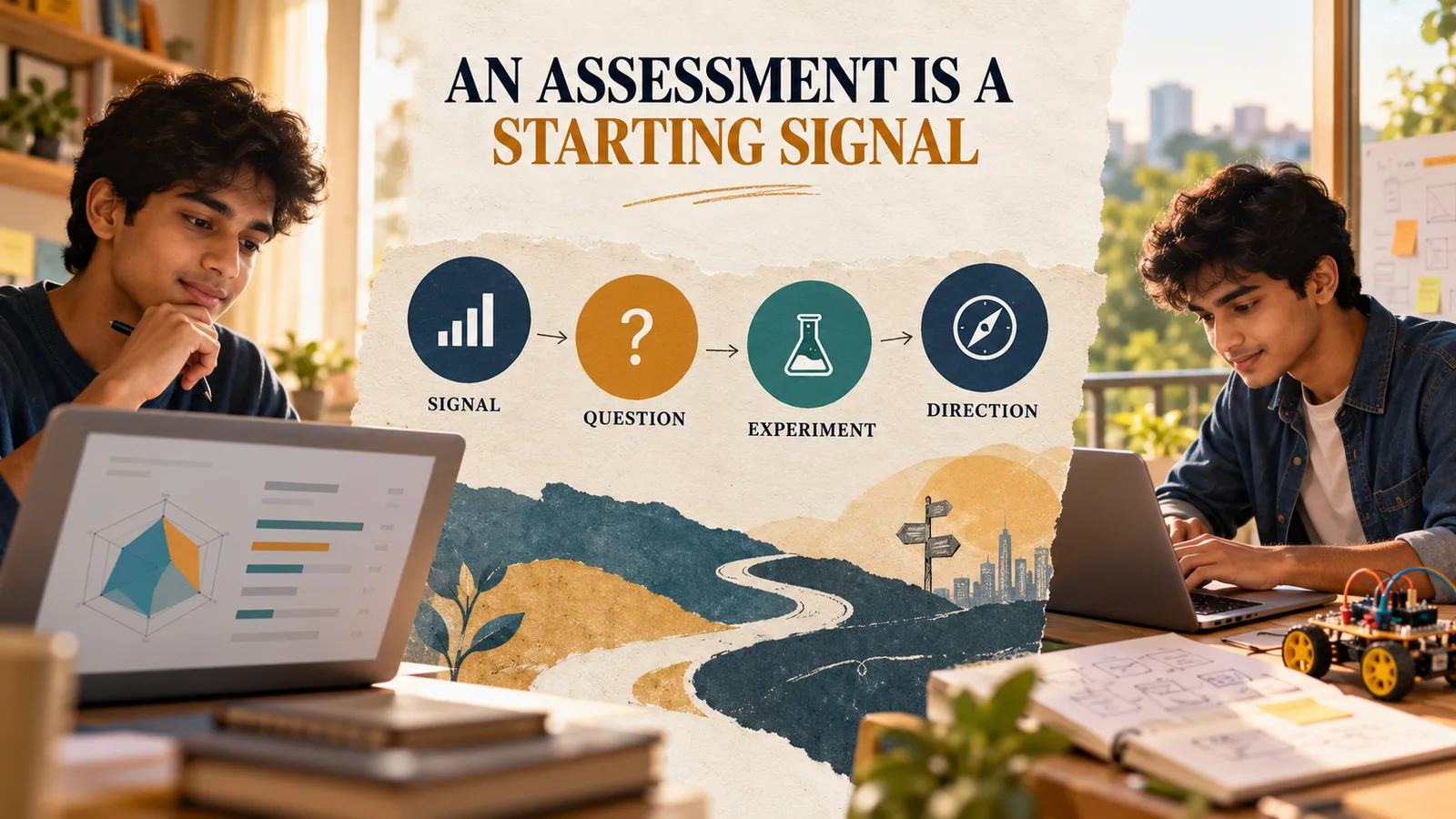
An assessment signal map showing how results become questions, experiments, and direction
Answer honestly

Rate each statement, then choose what you would do

There are no right answers on the statements, so think of your usual pattern, not your best day. In the situations, pick what you would really do, not what sounds best.

Which of these describes you best?

Setbacks look different at each stage, from marks and comparison to rejections and layoffs, so your report adjusts the advice to match.

It appears at the top of your result and in your PDF report. It stays on your device.
What is scored

Five resilience and growth mindset areas this self-assessment covers

These areas describe what people do after a bad result, when a task gets hard, and when feedback arrives. Each one is written as an everyday habit you can rate honestly and practise.

Bouncing back from setbacks

Recovering after a failure or rejection

High score: You feel the disappointment, reach out when you need support, and move to a next step without losing weeks to it.

Low score: A bad result stays with you for a long time, you carry it alone, or one failure makes you doubt the whole goal.

Belief that ability can grow

Seeing skills as something you can build

High score: You treat skills as things that improve with the right practice, and you learn from people who are ahead of you.

Low score: You tend to see ability as fixed, compare yourself with others and avoid situations where you might look weak.

Staying with hard tasks

Continuing when work becomes slow or boring

High score: You keep going through dull or difficult stretches and break long goals into steps.

Low score: You switch to easier things when a task gets hard, or stop when results do not show quickly.

Using feedback and mistakes

Turning errors and comments into improvement

High score: You look at your errors calmly, ask for feedback and change your method after a failure.

Low score: You feel defensive about corrections, hide mistakes or repeat the same method after it has failed.

Purpose and motivation over time

Keeping a goal alive for months

High score: You know why your goal matters to you and keep working on it when nobody is watching.

Low score: Your effort depends on praise or novelty, and you often switch goals when something new looks exciting.

How to read your resilience and growth mindset result

These are habits, not a verdict on you

Each statement describes something you do, such as writing down what to change after a mistake or sticking with a task for a set time. That makes these areas trainable. A lower score means a habit you have not practised yet, not a fixed trait or a flaw.

Resilience here does not mean coping alone or pushing through without rest. Telling a parent, teacher, senior or friend what is hard, and asking for help or feedback, is one of the habits this self-assessment looks for.

Why these five areas

Bouncing back, belief that ability can grow, staying with hard tasks, using feedback and keeping drive over time together describe how people handle low marks, backlogs, rejections, layoffs and plateaus. They are separate habits, so you can be strong in one and weak in another.

If you are a student, setbacks and mindset may be the first areas to look at because marks and comparison are everywhere. If you are searching for a job or restarting after a break, effort and drive may matter more, because preparation needs time to show.

Compare areas with each other, not with other people

Your scores come only from your own answers, so there is no pass mark and no ranking. Look at which area is lowest and which is highest, then use the plan for the lowest one. Retake the self-assessment after a month and compare area by area.

Turn scores into examples

A score alone convinces nobody. Pick your strongest area and write two real examples of what you did after a setback or a correction. Concrete stories are easier for an interviewer or a mentor to understand than labels like resilient or hardworking.

Limits to keep in mind

  • This is a self-rating tool and shows how you describe yourself. It does not replace feedback from teachers, seniors or people who work with you.
  • It is not a medical or mental-health assessment and cannot tell you whether you are coping well. If you feel unable to cope or have thoughts of harming yourself, please speak to a doctor, a counsellor or someone you trust. You can also call Tele-MANAS on 14416, a free national helpline.
  • It is not an employer or admission test and does not predict selection, performance or exam results.
  • Scores are not compared with other people, so there is no pass mark. Your result can change from week to week depending on what is happening in your life.
Common questions

Before you take the test

Is this resilience test free?

Yes. The self-assessment is free to take, and you get your area scores, advice for each answer you gave and a downloadable report without any payment.

Is this a growth mindset test?

One of the five areas, belief that ability can grow, covers how you think about skills, comparison and practice. The other four areas look at what you do after setbacks, on hard tasks, with feedback and over time, because a belief matters most when it shows up in habits.

Is this a grit test?

It covers the parts of grit people usually mean, staying with hard tasks and keeping a goal alive for months, as two of its five areas. It is a self-rating of your own habits with original statements, not a diagnosis or a label.

What is the difference between resilience and a growth mindset?

Resilience is how you respond after a setback, while a growth mindset is the belief that skills can improve with practice. They support each other: believing you can improve makes it easier to try again, and trying again after a setback gives that belief some evidence. This self-assessment scores both, along with effort, feedback and long-term drive.

Does being resilient mean handling everything on my own?

No. Asking a parent, teacher, senior, friend or counsellor for support is part of bouncing back, not a sign that you are weak. The setbacks area includes a statement about telling someone you trust, and the plans suggest who to talk to and what to ask.

How is the score worked out?

Statements are rated from 1 to 5, and the ones worded in the negative are reversed. In the situation questions, each option carries a score from 0 to 100. Each area score is the average of its statements and situations, shown out of 100, and the overall score is the average of the five areas.

What is a good score?

There is no pass mark. Scores are only against your own answers and are not compared with anyone else. A more useful question is which area is lowest for you today and what you will do about it in the next two weeks.

Can students and freshers use it?

Yes. The statements are about everyday habits after a bad result, a backlog, a rejection or a correction, so they apply to school students, college students, job seekers and working professionals. Your report adjusts the advice to the stage you choose.

Is this a mental health test?

No. It is a self-reflection tool about habits and is not a medical or mental-health assessment. If you feel unable to cope or have thoughts of harming yourself, speak to a doctor, a counsellor or someone you trust. You can call Tele-MANAS on 14416, a free national helpline.

Free results are step one

Free assessment results are useful. Real career decisions need stronger guidance.

Start with the free test that fits your stage. When the decision gets serious, move to updated career guidance that turns those signals into better choices, stronger skills, and higher leverage.

Use free results to narrow the problem before you commit to a bigger decision.

Use guidance to avoid wasted years, wasted money, and low-value skill choices.

Use the right plan for your stage to turn the result into a practical next step.

Sessions are online across India. The stronger plan gets built inside the guidance service.

Career Guidance Pricing

Students

Student path

Student Career Guidance

Practical student career guidance before the wrong path wastes years, money, and future readiness.

Limited-time student offer
₹3000
₹250
for the first 1-on-1 session

A low-friction first step before the wrong path costs more time and money.

Online across India

Avoid

Wrong streams, outdated degrees, and low-value skills that waste years and money.

Move toward

Useful skills, future readiness, and a clearer next decision.

Working Professionals

1-on-1

Working Professional Career Guidance

For professionals who need clearer pivots, stronger compensation, and higher-leverage career moves.

Limited-time professional offer
₹5000
₹3000
for one 1-on-1 session

Book one sharp 1-on-1 before stagnation, weak positioning, or a bad pivot gets more expensive.

Online across India

Avoid

Salary ceilings, random upskilling, weak positioning, and pivots that waste time and money.

Move toward

More useful skills, sharper positioning, and clearer next moves.