Listening
Understanding before replying
High score: You let people finish, check what they meant and respond to the point they made.
Low score: You tend to plan your reply while others talk, or miss details and have to ask again.
Communication is not one skill. Someone can write a clear email and freeze in a meeting, or speak well and miss what others say. Answer 34 questions (statements to rate and real situations to choose from, some chosen for your stage) and see your scores for listening, speaking, writing, handling feedback and presenting.
Self-rating tool for reflection. It is not a clinical, hiring or selection test.

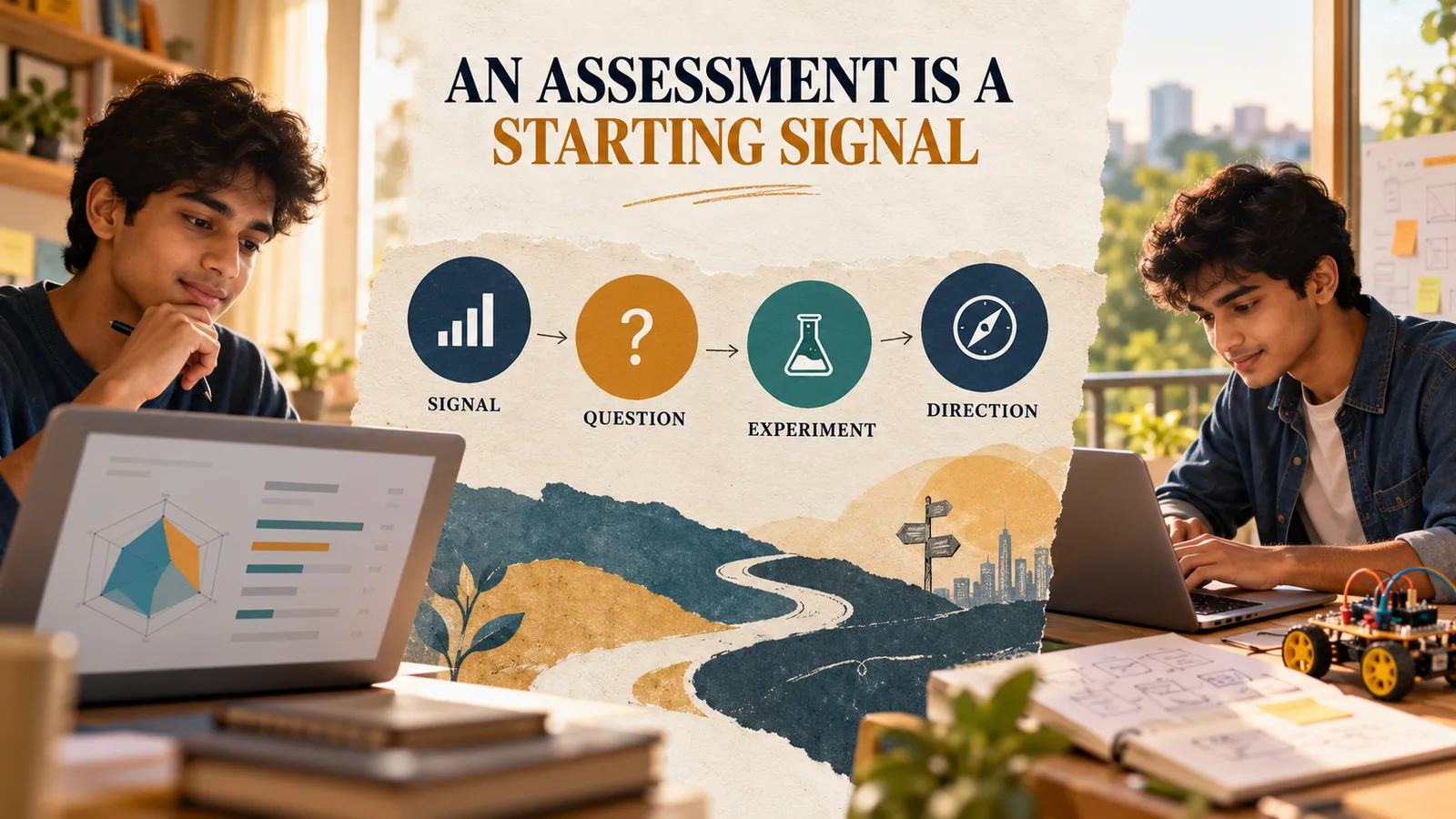
One test shows one side of you. Each full assessment combines interests, aptitude, thinking style, learning style and role or stream fit into a single report. Pick the one for your stage.
There are no right answers on the statements, so think of your usual pattern, not your best day. In the situations, pick what you would really do, not what sounds best.
Communication shows up differently at each stage, so your report adjusts the advice and the examples to match.
Interviews and workplaces often test communication as several separate things. These five areas show up in interviews, group discussions, emails and day-to-day work.
Understanding before replying
High score: You let people finish, check what they meant and respond to the point they made.
Low score: You tend to plan your reply while others talk, or miss details and have to ask again.
Saying one clear point at a time
High score: You organise your point before you speak and people usually understand you the first time.
Low score: You ramble, start before you know your point, or find others often ask you to repeat or explain.
Emails, messages and short documents
High score: Your messages are short, clear and easy to act on, with the request or point near the top.
Low score: Your messages run long, bury the request, or need follow-up questions before anyone can act.
Giving and receiving honest input
High score: You can hear criticism without getting defensive and can disagree politely and clearly.
Low score: You avoid disagreeing, take criticism personally, or let small issues grow because you do not raise them.
Speaking to a group or in an interview
High score: You stay fairly calm in front of others and can hold a group's attention for a few minutes.
Low score: Speaking to a group or in an interview makes you freeze, rush or avoid it altogether.
A single communication score hides what you can actually work on. Listening, speaking, writing, handling feedback and presenting are practised in different ways, and many people are clearly stronger in two or three of them.
Look at the gap between your highest and lowest area. If the gap is big, practice in the lowest area is the quickest way to improve your overall result.
Interviews test speaking and listening. Most office work depends on written messages. Team roles depend on feedback and disagreement, and leadership or client roles depend on presenting. Roles in sales, teaching, HR, content, consulting and management lean heavily on all five, and nearly every skilled role needs at least writing and listening.
Communication can be practised in any language and at any age, so it is a sensible skill to work on early in a career or course.
Some statements describe a habit you may want to drop, such as interrupting or avoiding speaking in a group. For these, agreeing lowers your score. Answer them as honestly as the others, because the report uses them to find where practice is needed.
In the situation questions, pick what you would really do on an ordinary day, not what you think is expected. A truthful answer gives a plan that fits you.
People tend to rate themselves differently from how others see them. After you read your report, ask two people you work or study with to rate you on the same five areas and compare. Differences are the most useful part.
It measures five areas from your own ratings: listening, speaking clearly, writing, giving and receiving feedback, and presenting. You get a score for each, an overall score and a two-week practice plan for your lowest area.
There is no pass mark. Scores are based only on your own answers, so use them to compare your five areas with each other and to choose what to practise first. Retake it after a few weeks to see whether your own scores have moved.
Each answer is converted into points for its area, and the area scores are combined into an overall score. For statements that describe an unwanted habit, such as interrupting, agreeing gives fewer points. Nothing is compared with other people.
Writing is one of the five areas, covering emails, messages and short documents. It does not grade grammar or vocabulary. It checks the habits that make written messages clear and easy to act on.
No. Communication here means how clearly and effectively you listen, speak, write and deal with feedback in any language. It is not a test of English fluency, accent or grammar.
Both can use it. The situations are everyday ones, such as class discussions, group projects, emails, interviews and teamwork, and some questions change with the stage you choose.
The report gives three specific practices for your lowest area. Practise for two weeks, then retake the assessment to see if the score moves. Asking two people for their view on the same area is also useful.
Practise out loud, not only in your head. Prepare a 30-second introduction and two short stories from your projects or work, say them to a friend who asks follow-up questions, and follow the two-week plan for your lowest area. Listening, writing and handling feedback count in interviews too, not only speaking.
Yes. It is free, needs no sign-up and the result can be downloaded as a PDF.
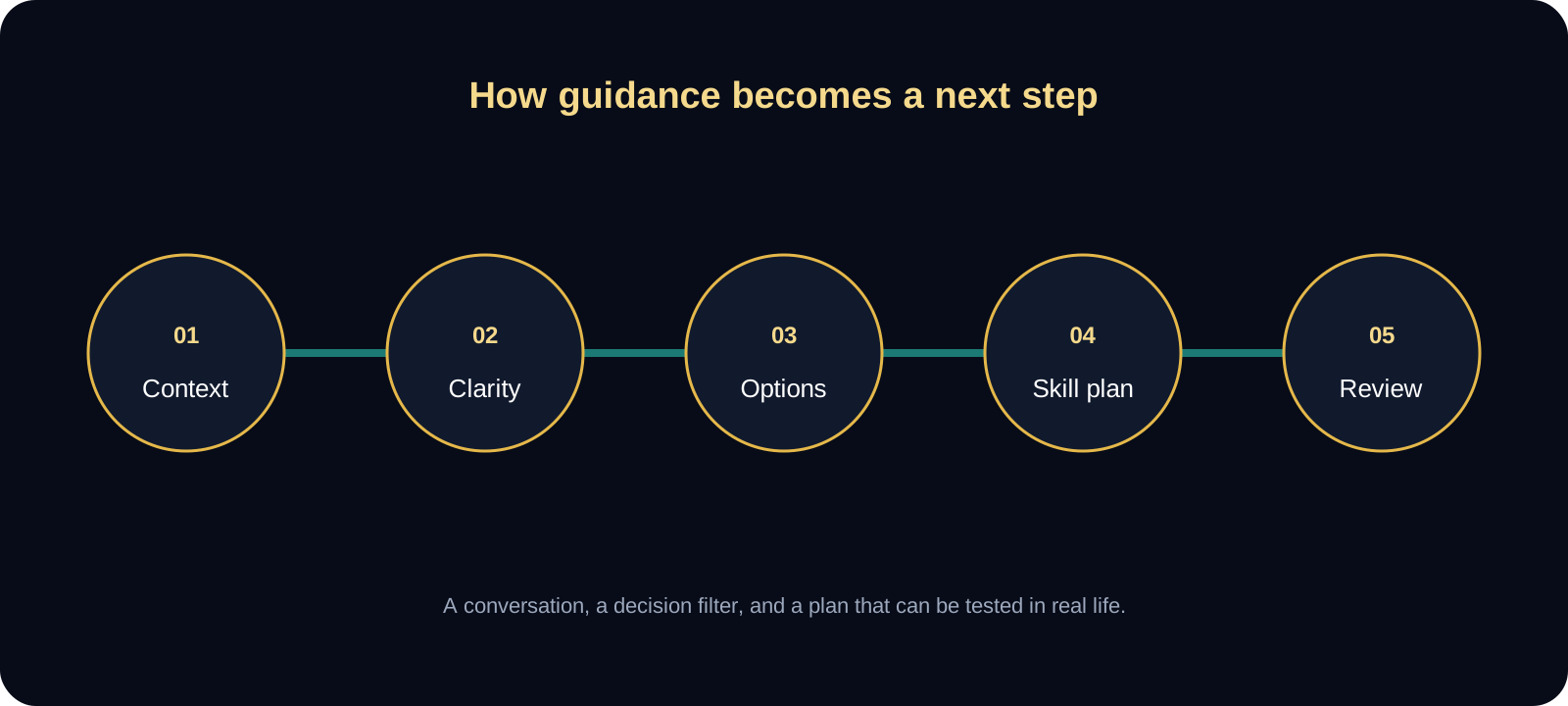
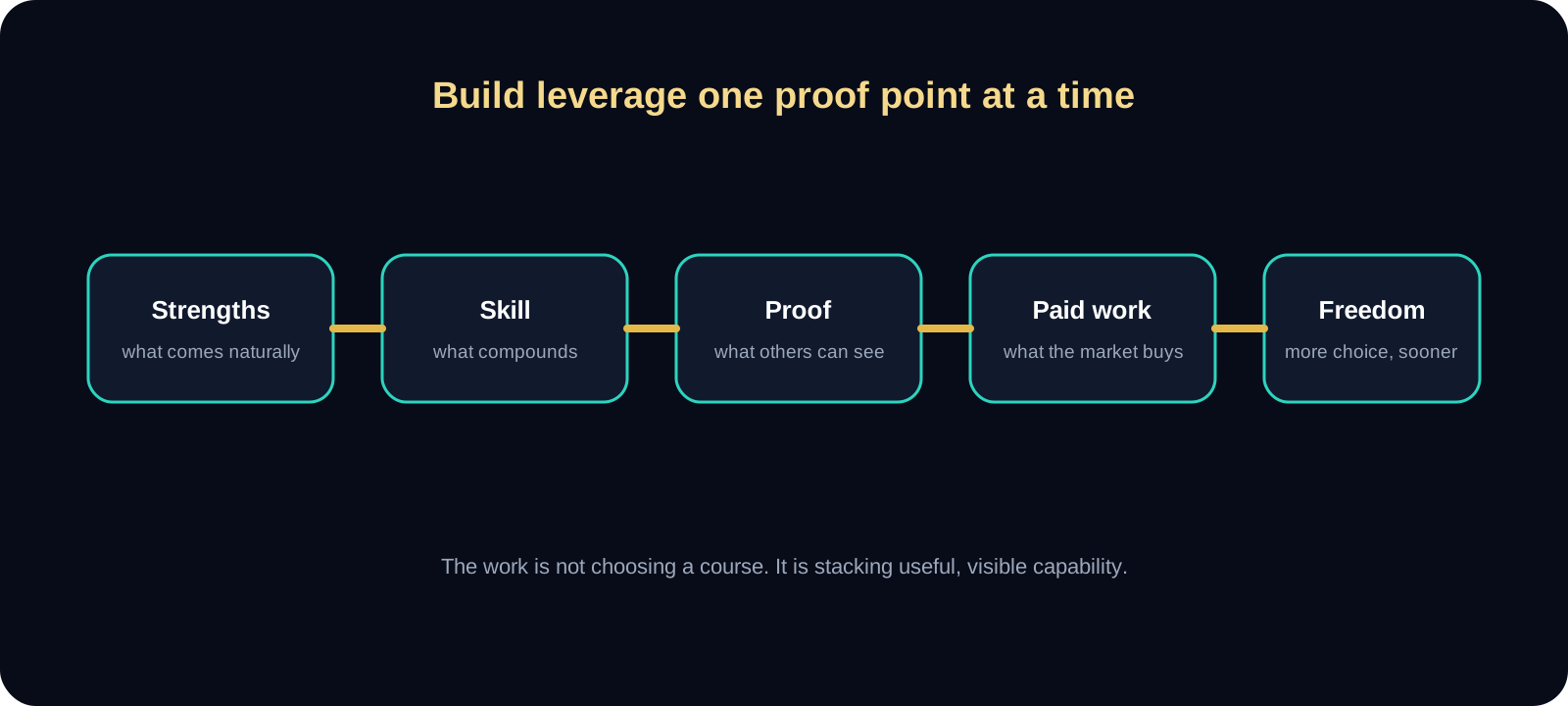
Start with the free test that fits your stage. When the decision gets serious, move to updated career guidance that turns those signals into better choices, stronger skills, and higher leverage.
Use free results to narrow the problem before you commit to a bigger decision.
Use guidance to avoid wasted years, wasted money, and low-value skill choices.
Use the right plan for your stage to turn the result into a practical next step.
Sessions are online across India. The stronger plan gets built inside the guidance service.
Practical student career guidance before the wrong path wastes years, money, and future readiness.
A low-friction first step before the wrong path costs more time and money.
Online across India
Wrong streams, outdated degrees, and low-value skills that waste years and money.
Useful skills, future readiness, and a clearer next decision.
Includes the 1-on-1 and up to 24 small-group sessions across the year.
Real student growth comes from a series of better decisions. This path keeps skill choices, future readiness, and review points visible across the year.
For professionals who need clearer pivots, stronger compensation, and higher-leverage career moves.
Book one sharp 1-on-1 before stagnation, weak positioning, or a bad pivot gets more expensive.
Online across India
Salary ceilings, random upskilling, weak positioning, and pivots that waste time and money.
More useful skills, sharper positioning, and clearer next moves.
AI pressure, stagnation, career pivots, and deciding which next skill move can multiply leverage.
One test shows one side of you. Each full assessment combines interests, aptitude, thinking style, learning style and role or stream fit into a single report. Pick the one for your stage.