Leading a class, a team or a business, in five habits

Leadership Skills Self-Assessment

Leading is not one skill. Some people set a clear goal but cannot let go of tasks. Others delegate well but avoid hard feedback, or decide fast but struggle to bring other teams along. Rate statements about what you actually do and choose how you would act in real situations, and see which leadership habit to build first. This goes much deeper than the single leadership area in the soft skills assessment.

40questions
5leadership areas
FreePDF report
Want more than one result? Take the full free career assessment for your stage: 6 tests in one report →

Self-rating tool for reflection. It is not a clinical, hiring or selection test.

A student taking an online career assessment on a tablet
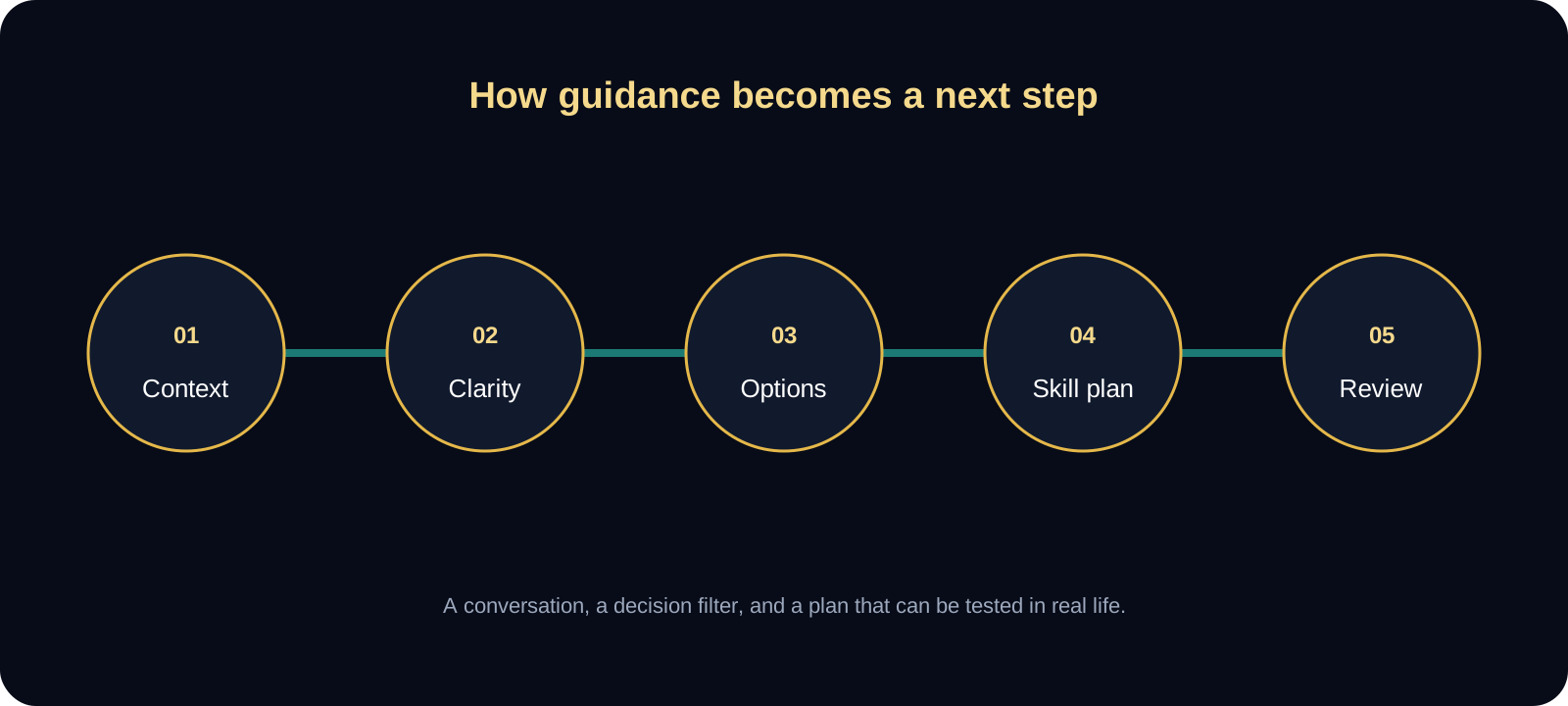
Five-stage career guidance session flow from context to review
A guidance session moves from context to clarity, options, a skill plan and review.
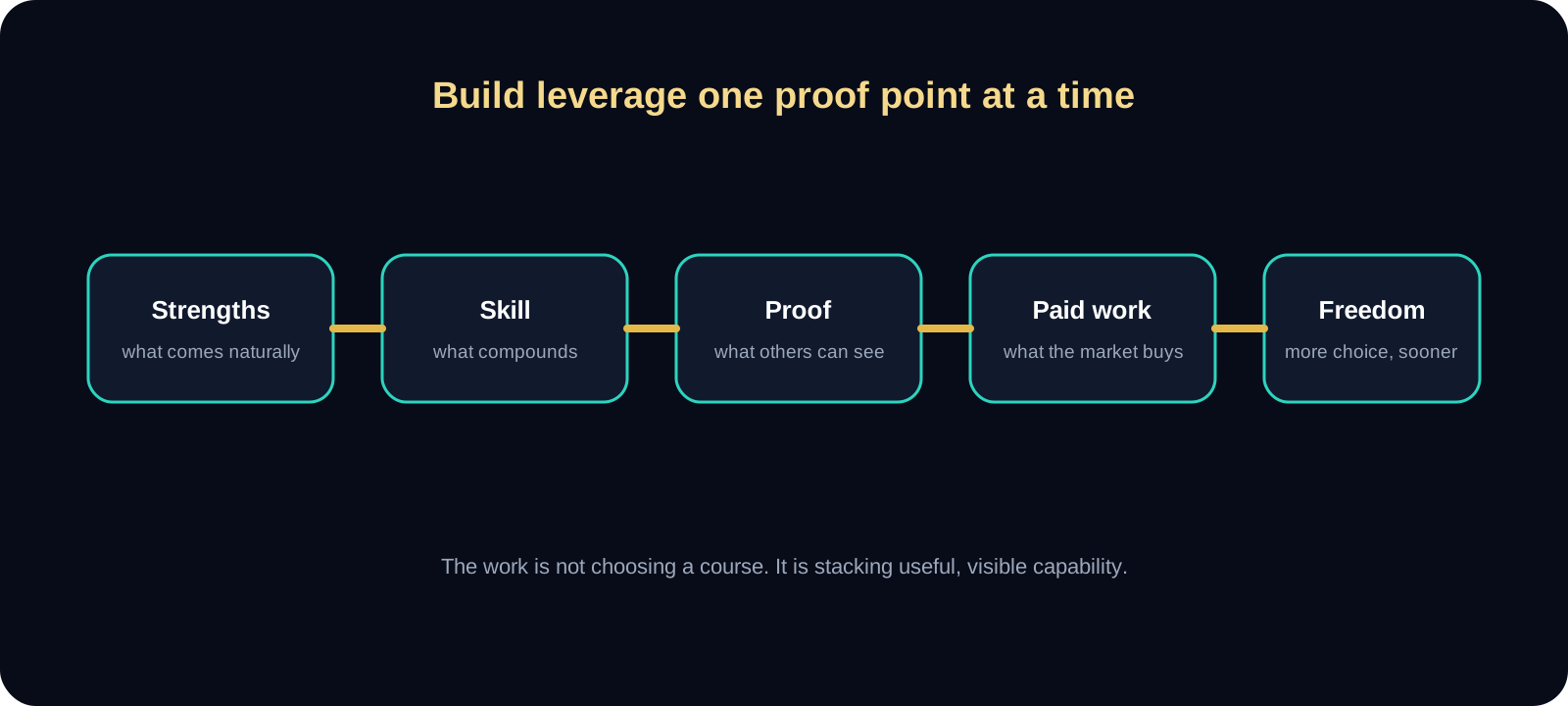
Skill portfolio chain from strengths to financial freedom
Strengths become skills, skills become visible proof, and proof leads to paid work and more freedom.
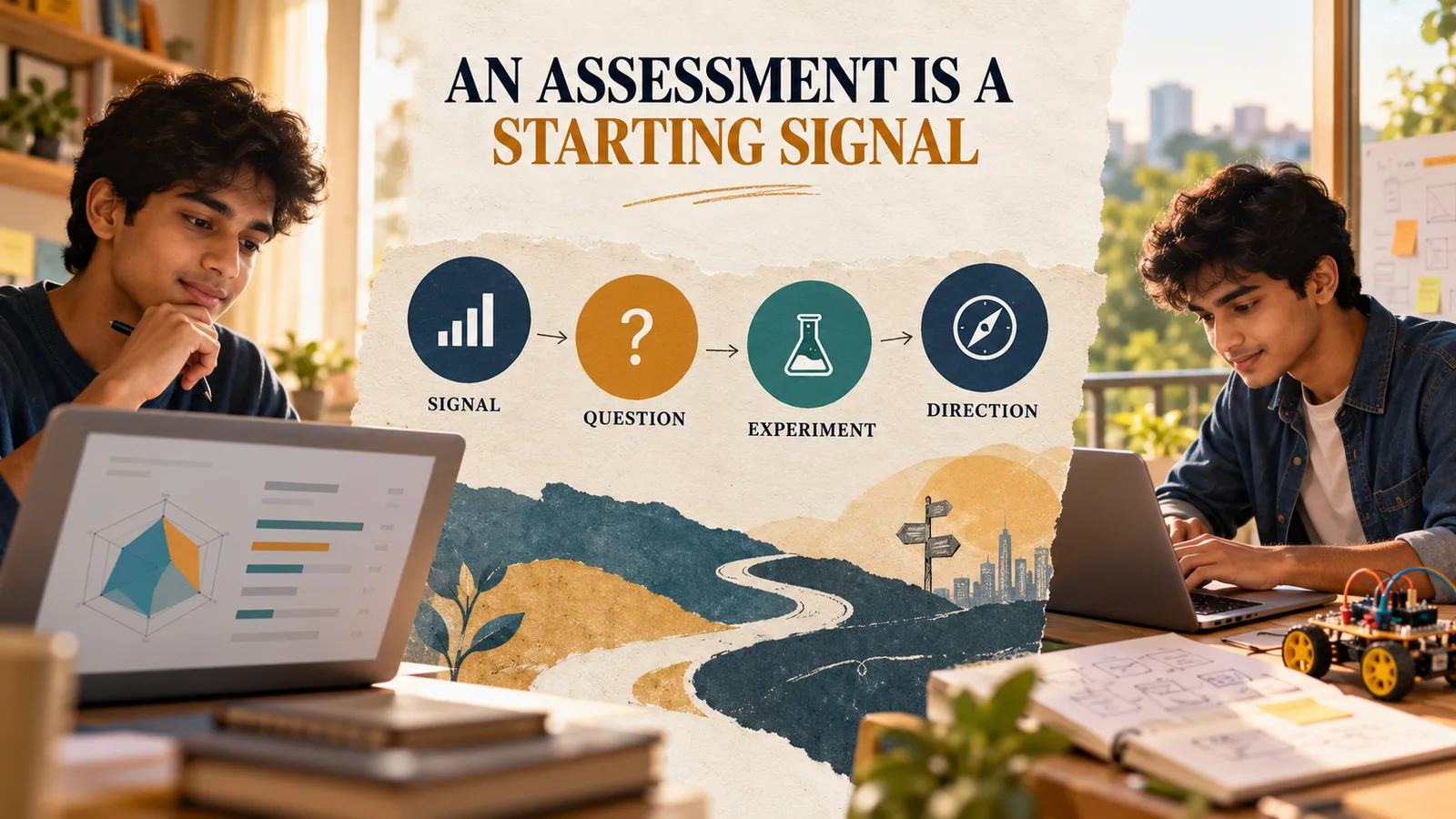
An assessment signal map showing how results become questions, experiments, and direction
Answer honestly

Rate each statement, then choose what you would do

There are no right answers on the statements, so think of your usual pattern, not your best day. In the situations, pick what you would really do, not what sounds best.

Which of these describes what you lead?

Leading a class club, a first team, a department and a small business are very different jobs, so your report changes the questions and the advice to match.

It appears at the top of your result and in your PDF report. It stays on your device.
What is scored

Five leadership habits this self-assessment covers

Leadership shows up in small, repeatable behaviours: how you set the goal, hand over work, speak about performance, decide when time is short and move people who do not report to you. Each area below is written as something you can rate honestly and practise.

Setting direction and goals

Making the goal, the priority and the reason clear

High score: People around you know what the goal is, why it matters and what comes first this week, and you say what will wait.

Low score: You assume everyone knows the goal, or the priority changes so often that people stop trusting what you said last week.

Delegating and trusting

Handing over work with clarity and letting go

High score: You hand over tasks with a clear result, a deadline and a check-in point, and you let people do them their own way.

Low score: You keep tasks because it is faster to do them yourself, or you hand them over vaguely and then redo what comes back.

Coaching and feedback

Helping people improve through timely, specific talk

High score: You speak up early about problems, give feedback on specific actions, ask questions before giving answers and ask for feedback yourself.

Low score: You wait until a problem is serious, give vague comments or avoid the difficult conversation, and rarely ask how you are doing as a leader.

Deciding under pressure

Choosing and owning a call when time is short

High score: You decide with the information available, say what is still unknown, stay steady in front of the group and learn from calls that go wrong.

Low score: You wait for full agreement, push hard calls to someone senior, or react sharply when things go wrong.

Influence without authority

Moving people who do not report to you

High score: You find out what others care about, build relationships before you need them, persuade with facts or small trials and share credit.

Low score: You depend on your title or on repeating your opinion more strongly, and you approach other teams only when you need something.

How to read your leadership skills result

Leadership is a set of habits, not a type

Your five scores describe what you tend to do when you lead: setting direction, handing over work, speaking about performance, deciding under pressure and moving people without authority. They do not label you as a certain kind of leader. Most people are stronger in two areas and weaker in one or two, and the weaker ones can be practised.

Why this goes beyond a one-area leadership score

A single leadership score hides the difference between a person who sets a clear goal but never delegates and a person who delegates easily but avoids feedback. Splitting leadership into five habits shows which part to work on. If you have already taken the soft skills assessment, treat this one as the detailed version of its leadership area.

You do not need a title to practise these

A class representative, a project member who coordinates, a club captain, a freelancer who hires help and a manager of fifty people all use the same five habits at different scales. The stage you choose before you start changes the situations and the advice, so the report speaks to what you actually lead.

Check your ratings with the people you lead

Leadership is judged by others as much as by you. If your ratings differ from what a teammate, junior, classmate or manager would say, the gap is worth knowing about. Your report includes a question for each area that you can ask someone who works with you, and then you can retake the assessment after two weeks of practice.

Limits to keep in mind

  • This is a self-rating tool and shows how you describe your own habits. People who work with you may see them differently, so ask them too.
  • It describes leadership habits, not a fixed leadership style or type, and it does not label you as a certain kind of leader.
  • It is not a psychological test, a personality profile or a diagnosis, and it does not predict selection, promotion or performance in any role.
  • Scores are not compared with other people, so there is no pass mark. They only show how your five areas compare with each other.
  • It does not cover technical, domain or business knowledge, which a leadership role may also need.
Common questions

Before you take the test

What is a leadership skills test?

It is a set of statements and real-life situations about how you lead. You rate yourself, and the report scores five areas: setting direction, delegating, coaching and feedback, deciding under pressure and influencing without authority.

Is this a leadership style assessment? Will it give me a leadership type?

No. It describes leadership habits, not a fixed type. Two people with the same overall score can have very different strong and weak habits, and the same person can lead differently in a class, a project and a business. The report shows what to practise, not who you are.

Am I a good leader? What is a good score?

This test cannot say whether you are a good leader, because there is no pass mark and no comparison with other people. Your scores are based only on your own answers, so they cannot say whether you are a good leader. The useful reading is which of the five areas is lowest and which is highest, and what the people you lead would say about each.

How can I improve my leadership skills after taking the test?

Start with your lowest-scoring area and practise its two-week routine on something you really lead, such as a class project, a team task or a shop. Ask two people who work with you whether they agree with your ratings, act on one point they give, and retake the assessment after two weeks to see what moved. The test does not measure leadership potential or predict who gets chosen to lead, so use it to plan practice and not to judge your future.

How is this different from the soft skills assessment?

The soft skills assessment includes leadership as one of five areas, along with teamwork, adaptability, ownership and problem solving. This leadership self-assessment is only about leadership, split into five habits with situations and advice for different stages. Take the soft skills one for a broad view and this one for depth.

Is this leadership test free, and how long does it take?

Yes, it is free. It takes about 8 minutes, needs no sign-up, and shows your result straight away along with a downloadable PDF report.

How is the score worked out?

Statements are rated from 1 to 5, and statements worded in the negative are reversed. In the situation questions, each option carries a score from 0 to 100. Each area score is the average of its statements and situations, shown out of 100, and the overall score is the average of the five areas.

Can students and people without a team use it?

Yes. You choose the stage that fits you: student or club or class leader, first-time team lead, experienced manager, or founder, freelancer or small-business owner. A few statements and the advice change to match what you actually lead.

Free results are step one

Free assessment results are useful. Real career decisions need stronger guidance.

Start with the free test that fits your stage. When the decision gets serious, move to updated career guidance that turns those signals into better choices, stronger skills, and higher leverage.

Use free results to narrow the problem before you commit to a bigger decision.

Use guidance to avoid wasted years, wasted money, and low-value skill choices.

Use the right plan for your stage to turn the result into a practical next step.

Sessions are online across India. The stronger plan gets built inside the guidance service.

Career Guidance Pricing

Students

Student path

Student Career Guidance

Practical student career guidance before the wrong path wastes years, money, and future readiness.

Limited-time student offer
₹3000
₹250
for the first 1-on-1 session

A low-friction first step before the wrong path costs more time and money.

Online across India

Avoid

Wrong streams, outdated degrees, and low-value skills that waste years and money.

Move toward

Useful skills, future readiness, and a clearer next decision.

Working Professionals

1-on-1

Working Professional Career Guidance

For professionals who need clearer pivots, stronger compensation, and higher-leverage career moves.

Limited-time professional offer
₹5000
₹3000
for one 1-on-1 session

Book one sharp 1-on-1 before stagnation, weak positioning, or a bad pivot gets more expensive.

Online across India

Avoid

Salary ceilings, random upskilling, weak positioning, and pivots that waste time and money.

Move toward

More useful skills, sharper positioning, and clearer next moves.