Planning, focus, learning method, revision and rest in one report

Study Habits Self-Assessment

Many students work hard and still feel they are not studying the right way. This free self-assessment turns "how good are my study habits" into five concrete areas: planning, focus, how you learn, revision and rest. It shows which one to fix first, whether you are in school, preparing for an entrance or government exam, in college, or studying alongside a job.

40questions
5habit areas
FreePDF report
Want more than one result? Take the full free career assessment for your stage: 6 tests in one report →

Self-rating tool for reflection. It is not a clinical, hiring or selection test.

A student taking an online career assessment on a tablet
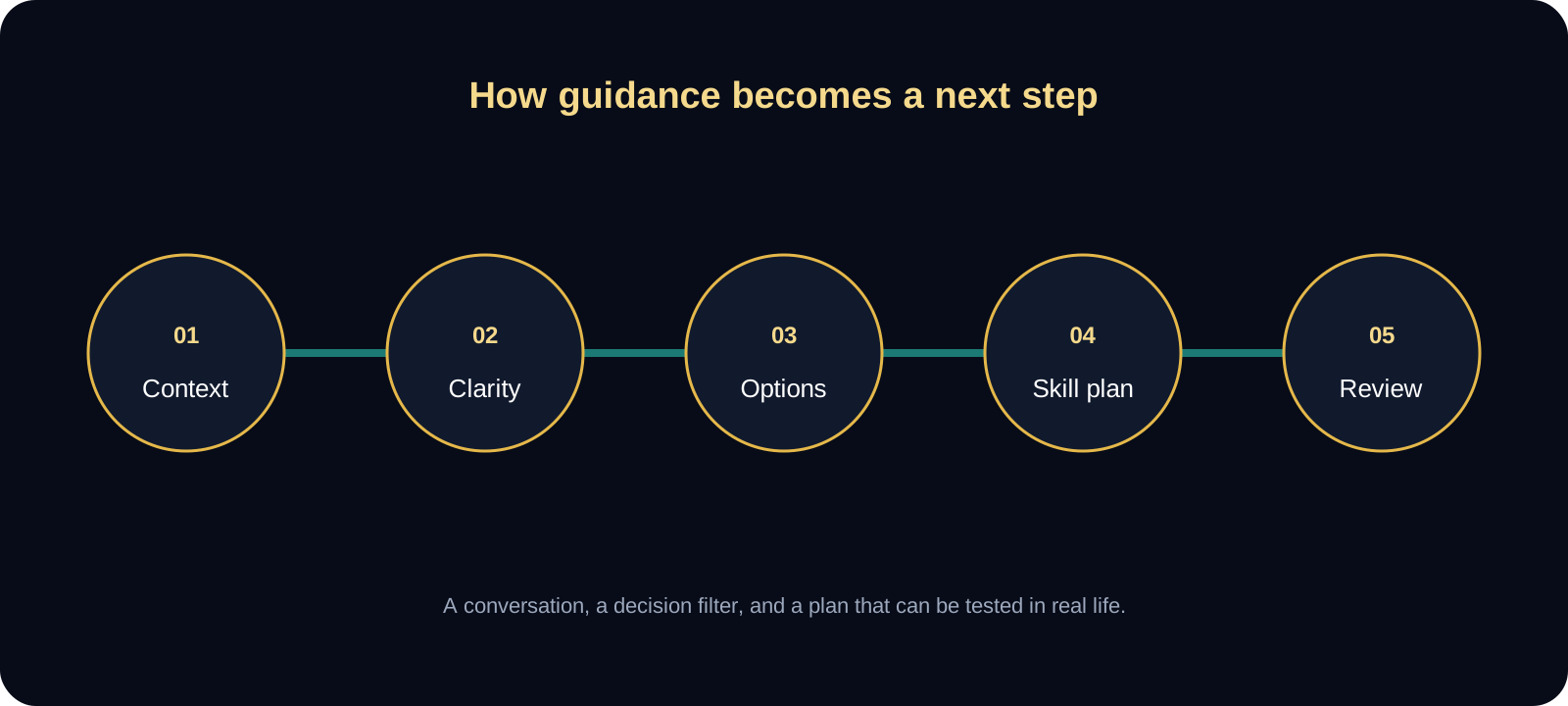
Five-stage career guidance session flow from context to review
A guidance session moves from context to clarity, options, a skill plan and review.
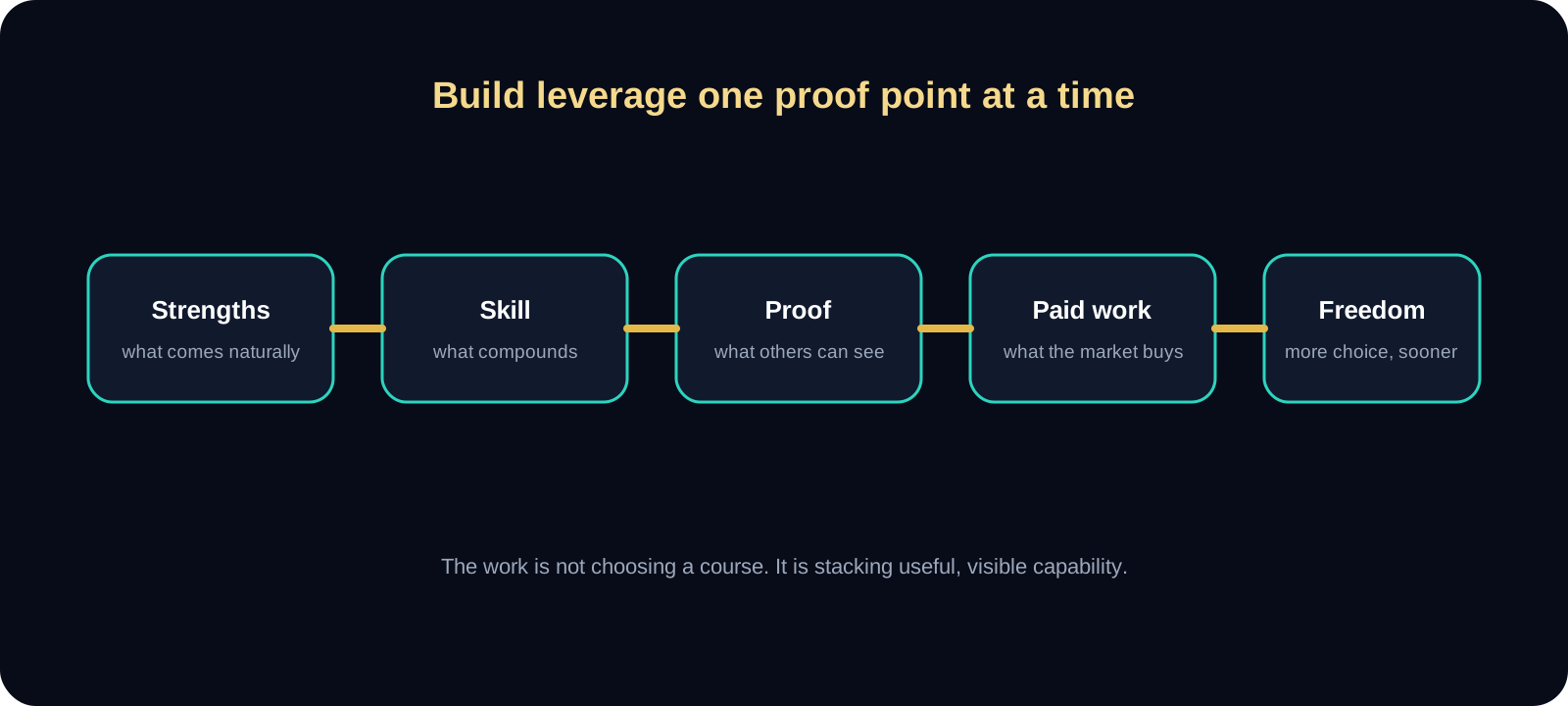
Skill portfolio chain from strengths to financial freedom
Strengths become skills, skills become visible proof, and proof leads to paid work and more freedom.
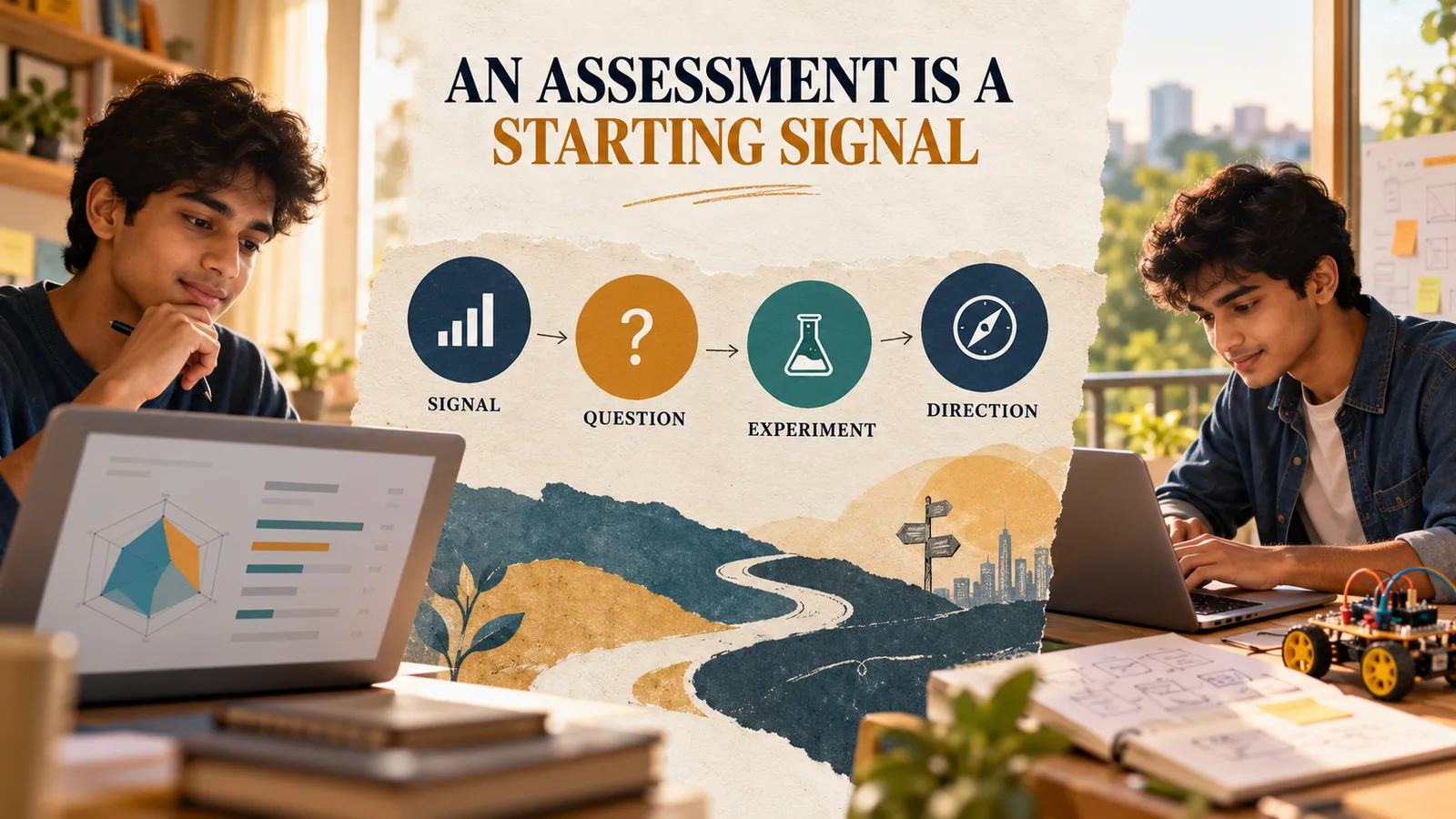
An assessment signal map showing how results become questions, experiments, and direction
Answer honestly

Rate each statement, then choose what you would do

There are no right answers on the statements, so think of your usual pattern, not your best day. In the situations, pick what you would really do, not what sounds best.

Which of these describes you best?

Good study habits look different in each stage, so your report changes the extra questions and advice to match your timetable.

It appears at the top of your result and in your PDF report. It stays on your device.
What is scored

Five study habit areas this self-assessment covers

Hours of study matter less than how those hours are planned, protected, used and revisited. Each statement belongs to one of these areas, and your lowest area is the one to fix first.

Planning your study

Knowing what to study, when and for how long

High score: You know what you will study each day, you plan backwards from dates, and you do not leave hard topics for the last minute.

Low score: You often decide what to study only after sitting down, or plans exist in your head and fall apart when the week gets busy.

Focus and distractions

Staying with one task without drifting away

High score: You can stay with one topic for a full session, and you have set up your place and phone so that distractions are hard to reach.

Low score: Phone, messages, videos or noise pull you away many times in a session, so long hours of sitting give you little real study.

How you learn

Understanding, recalling and practising, not just reading

High score: You study actively: you explain topics in your own words, solve problems yourself and look for the reason behind a rule.

Low score: You mostly read, highlight or copy, and you memorise without understanding, so topics feel known until a question is asked in a new way.

Revision and self-testing

Coming back to topics and checking what you remember

High score: You return to topics at spaced intervals, test yourself before looking at answers, and learn from the mistakes you make.

Low score: You revise only near the exam, or you re-read until the page looks familiar without checking whether you can recall it.

Sleep, breaks and study conditions

Resting enough to keep studying well

High score: You sleep at fairly regular times, take real breaks, eat on time and study in a place that is comfortable enough to last.

Low score: Late nights, skipped meals, long sessions without a break or a poor study spot leave you tired, so the hours you put in give less back.

How to read your study habits result

Habits are things you do, not how clever you are

Every statement describes something you do, such as writing a weekly plan or testing yourself before checking the answer. Because they are actions, they can be changed. A lower score means a habit you have not set up yet, not a limit on what you can learn.

Rate what you do in an ordinary week, not in the week before an exam and not what you plan to do from Monday. Honest ratings show the real gap, and the advice is built from that gap.

Why these five areas

Planning decides what you study, focus decides how much of the time is real study, and method decides whether the study turns into understanding. Revision decides whether you still remember it later, and rest decides whether you can keep going for months.

A weak area is often hidden by a strong one. A student with good planning and poor revision can study every day and still feel unprepared before a test. This is why the report shows five scores and not one.

Fix one area at a time

Start with your lowest area and run its two-week routine before touching the others. Changing five habits at once usually fades by the end of the first week.

Your stage matters too. A Class 10 student with school and tuition, a JEE or NEET aspirant balancing coaching and self-study, a college student facing internal assessments and a working adult with evening hours need different fixes for the same habit. The report adjusts the advice to the stage you choose.

Retake after a few weeks

Retake the self-assessment after you have followed the routine for a few weeks and compare area by area. Compare with your own earlier scores only. A change in the area you worked on is a useful sign, though your own record of tests and finished plans is a better check.

Limits to keep in mind

  • This is a self-rating tool and shows how you describe your own habits. It does not measure intelligence, ability or how well you will do in an exam.
  • There is no pass mark. Scores are not compared with other people, only with your own answers and your own earlier results.
  • It is not a medical or mental-health assessment. If you feel unable to cope with study pressure, are not sleeping or eating properly for a long time, or have thoughts of harming yourself, please speak to a doctor, a counsellor or someone you trust. You can call Tele-MANAS on 14416, the free national helpline.
  • It does not know your syllabus, board, exam pattern or subjects, so use the advice to shape your routine and check specifics with your teacher or mentor.
Common questions

Before you take the test

What is a study habits test?

It is a way to rate the things you actually do when you study: how you plan, whether you stay focused, how you learn a topic, how you revise and whether you rest well. This one gives a score for each of the five areas from your own ratings and shows where to start.

Is this study habits assessment free?

Yes. You can take it, see your result and download the report without paying or signing up.

How good are my study habits? What is a good score?

There is no pass mark. Scores are only against your own answers, not against other students. A higher score in an area means that habit is already working for you, and your lowest area is simply the best place to begin.

How do I know if I am studying the right way?

Look at the method and revision scores first. If you mostly read and highlight, and rarely explain, practise or test yourself, long hours may give less than they should. The report shows which habits to change and gives a two-week routine for the weakest one.

How is the score worked out?

Statements are rated from 1 to 5 and the ones worded as an unwanted habit are reversed. In the situation questions, each option carries a score from 0 to 100. Each area score is the average of its statements and situations, shown out of 100, and the overall score is the average of the five areas.

Can school students, college students and working adults use it?

Yes. You choose your stage, Class 6 to 10, Class 11 and 12 with entrance preparation, college, or exam preparation and upskilling alongside work. A few extra questions and the advice change with the stage, because a board-exam timetable, a coaching schedule, a semester and a working day all need different routines.

How can I improve my study habits?

Pick one habit area and change it for two weeks before touching the rest. The report picks your lowest area and gives a 14-day routine for it, such as keeping the phone in another room during study blocks or explaining each topic aloud before checking the book.

How long does the study habits test take?

It takes about eight minutes. You rate statements about what you do when you study and answer a few short situation questions. You can read your result straight away and download the report.

Is this a medical or mental-health test for stress?

No. It looks only at everyday study habits and does not diagnose anything. If study pressure feels too heavy, you cannot sleep or eat properly for a long time, or you have thoughts of harming yourself, please talk to a doctor, a counsellor or someone you trust, and you can call Tele-MANAS on 14416, the free national helpline.

How is this different from a learning style test?

A learning style test asks how you prefer to take in information. This one asks what you do before, during and after a study session. The two work together: your preferences can shape how you practise, while the habits decide whether the practice happens.

Free results are step one

Free assessment results are useful. Real career decisions need stronger guidance.

Start with the free test that fits your stage. When the decision gets serious, move to updated career guidance that turns those signals into better choices, stronger skills, and higher leverage.

Use free results to narrow the problem before you commit to a bigger decision.

Use guidance to avoid wasted years, wasted money, and low-value skill choices.

Use the right plan for your stage to turn the result into a practical next step.

Sessions are online across India. The stronger plan gets built inside the guidance service.

Career Guidance Pricing

Students

Student path

Student Career Guidance

Practical student career guidance before the wrong path wastes years, money, and future readiness.

Limited-time student offer
₹3000
₹250
for the first 1-on-1 session

A low-friction first step before the wrong path costs more time and money.

Online across India

Avoid

Wrong streams, outdated degrees, and low-value skills that waste years and money.

Move toward

Useful skills, future readiness, and a clearer next decision.

Working Professionals

1-on-1

Working Professional Career Guidance

For professionals who need clearer pivots, stronger compensation, and higher-leverage career moves.

Limited-time professional offer
₹5000
₹3000
for one 1-on-1 session

Book one sharp 1-on-1 before stagnation, weak positioning, or a bad pivot gets more expensive.

Online across India

Avoid

Salary ceilings, random upskilling, weak positioning, and pivots that waste time and money.

Move toward

More useful skills, sharper positioning, and clearer next moves.