For students, freshers, working professionals and people returning to work

Career Readiness Self-Assessment

Being ready for a career is not only about a degree. Feeling stuck often comes down to one of five things: a clear direction, skills they can use, proof of what they can do, people who know their work, or a steady way of searching. This free self-assessment rates all five from your own answers, then shows which one to fix first and how to start this week.

40questions
5readiness areas
FreePDF report
Want more than one result? Take the full free career assessment for your stage: 6 tests in one report →

Self-rating tool for reflection. It is not a clinical, hiring or selection test.

A student taking an online career assessment on a tablet
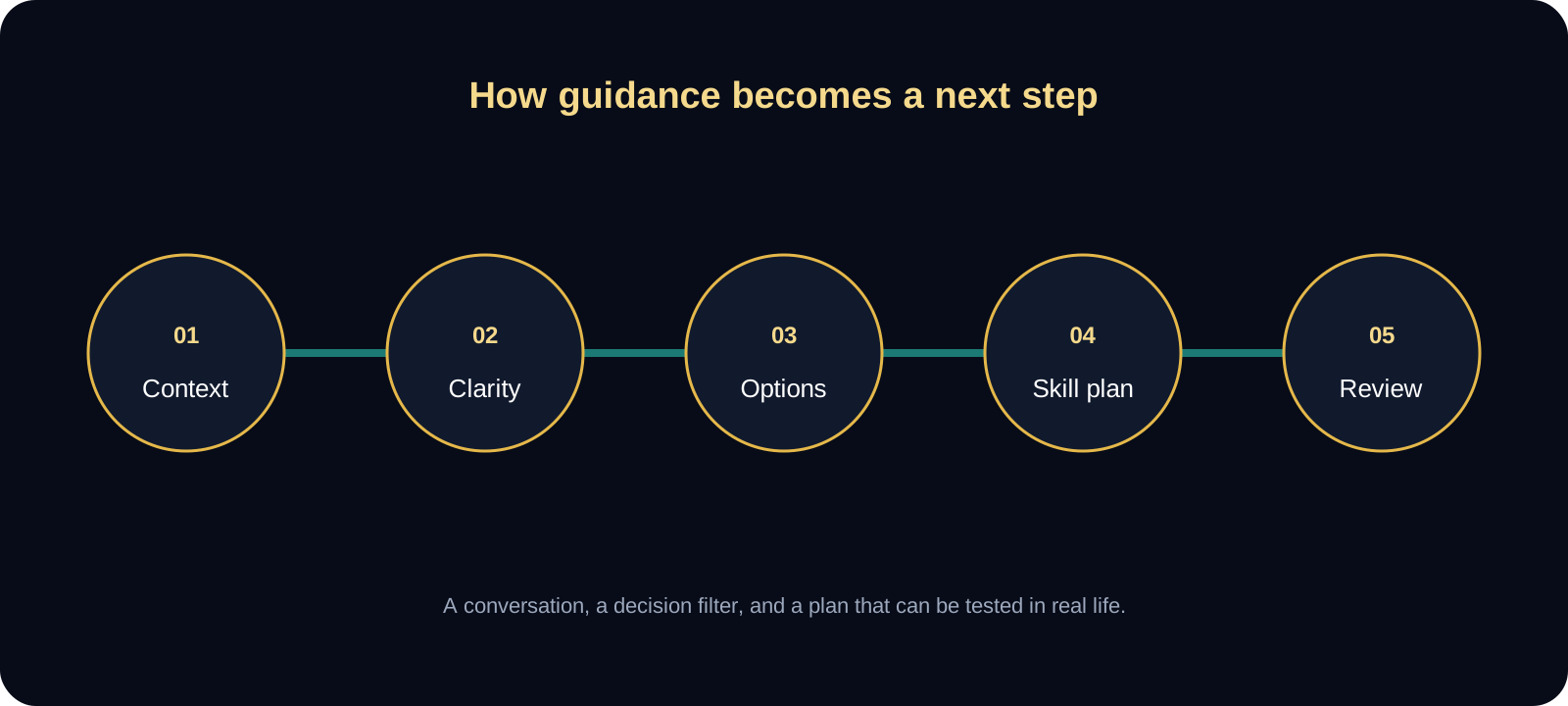
Five-stage career guidance session flow from context to review
A guidance session moves from context to clarity, options, a skill plan and review.
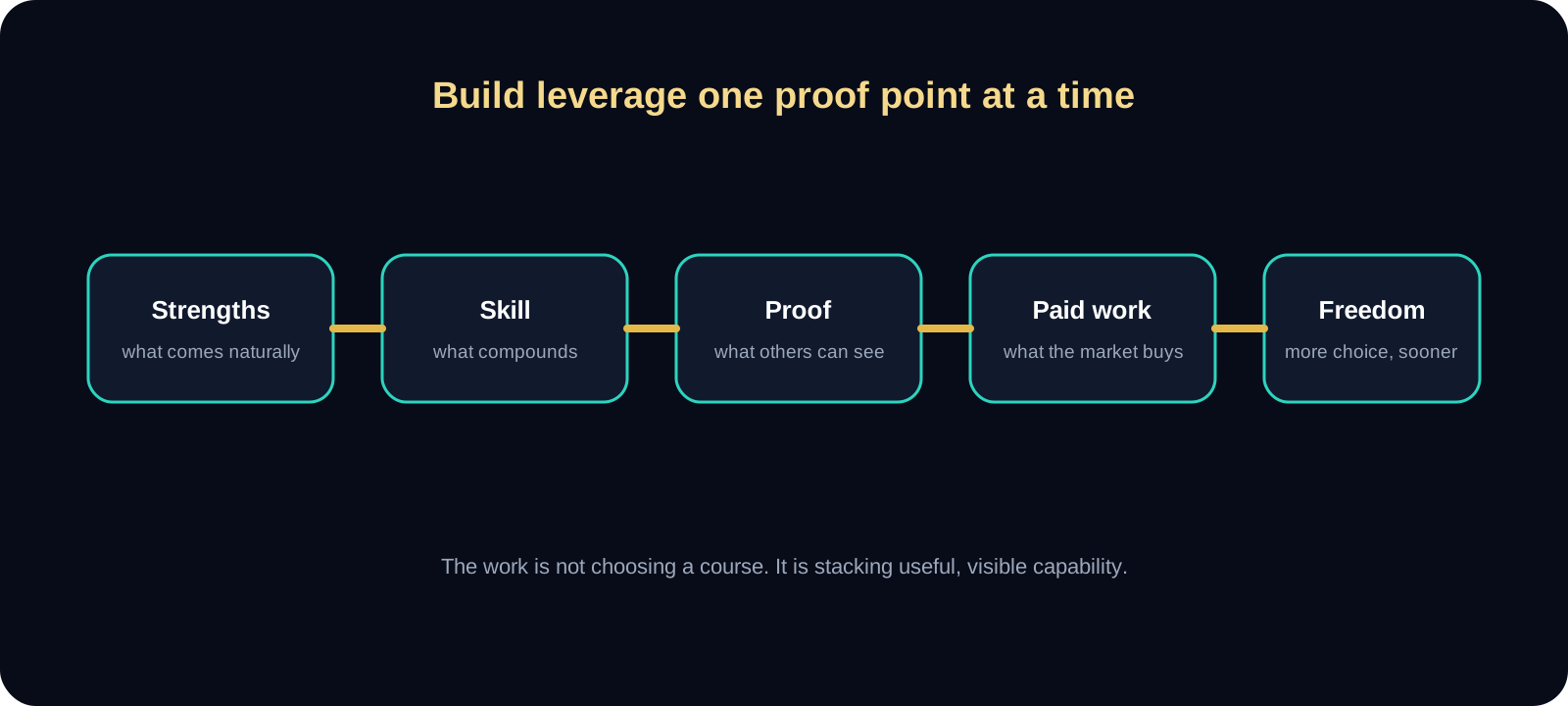
Skill portfolio chain from strengths to financial freedom
Strengths become skills, skills become visible proof, and proof leads to paid work and more freedom.
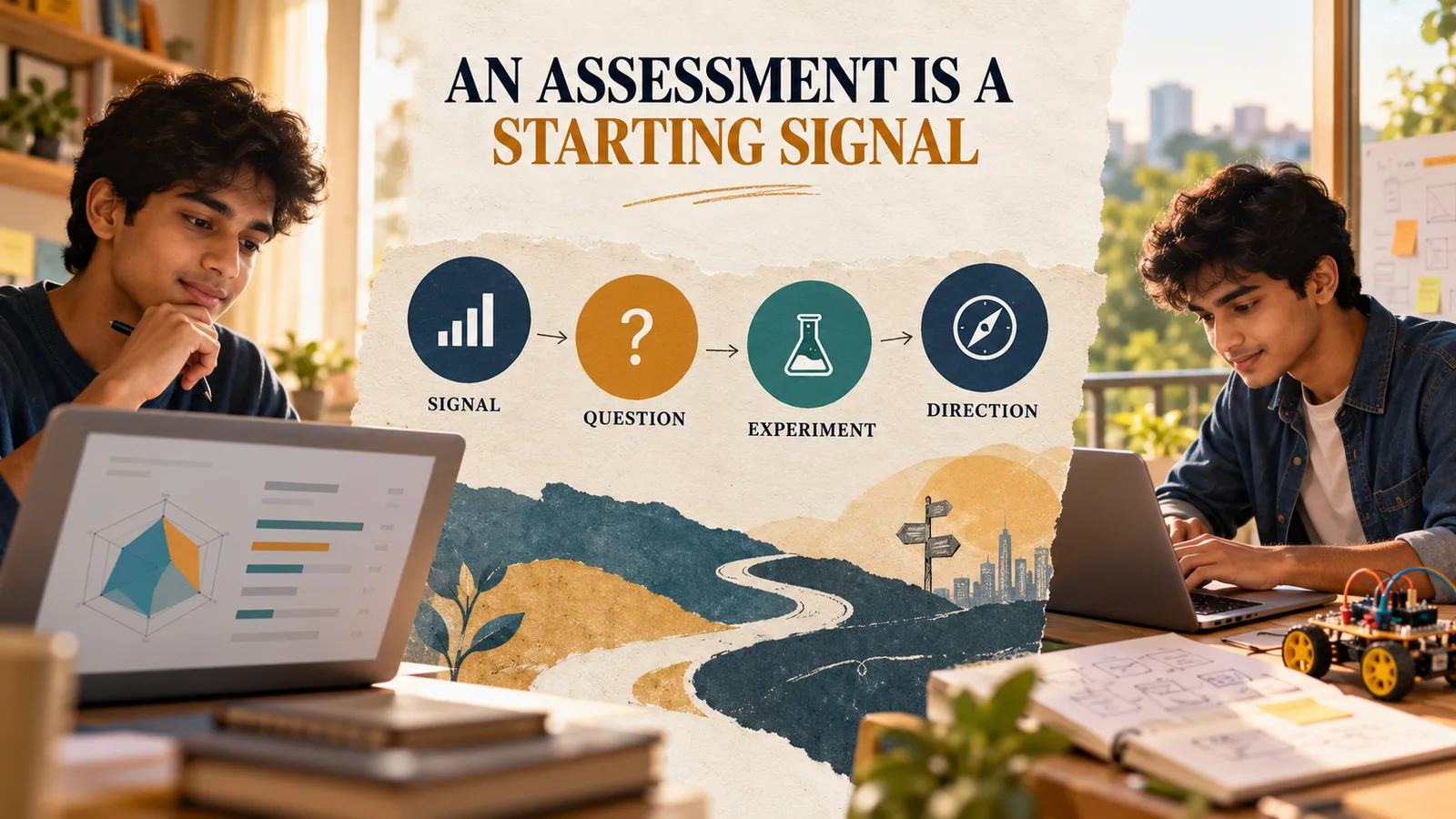
An assessment signal map showing how results become questions, experiments, and direction
Answer honestly

Rate each statement, then choose what you would do

There are no right answers on the statements, so think of your usual pattern, not your best day. In the situations, pick what you would really do, not what sounds best.

Which of these describes you right now?

A first-year student, a final-year student, a working professional and someone returning after a break need different next steps, so your report adjusts the advice to match.

It appears at the top of your result and in your PDF report. It stays on your device.
What is scored

Five career readiness areas this self-assessment covers

A degree is one part of readiness. Employers, clients and colleagues also look at what you can do, what you can show and whether they know you exist. These five areas turn that into habits you can rate honestly and improve.

Knowing the career you are aiming for

A target you have tested, not just heard about

High score: You can name the roles you are aiming for, say what they involve day to day and explain why they suit you, with a back-up in mind.

Low score: Your plan comes mostly from what others around you are choosing, or it changes every few weeks before anything is tried properly.

Skills you can actually use

What you can do, not only what you have studied

High score: You know which skills your target role needs, you practise them on real tasks and you can say honestly where you are strong and weak.

Low score: You have studied or watched a lot, but you have not used the skills on real tasks, or you are learning many things without finishing any.

Proof of work: projects, portfolio, results

Things you can show, not only things you can say

High score: You have work you can show in a minute, you can explain your own part and the result, and someone outside your family has seen it.

Low score: Your resume lists skills and courses, but you have little you can open, show or point to as evidence of what you can do.

People and visibility

Who knows your work and what you are looking for

High score: You know people in your target field, you ask them focused questions and your profile and work are visible to those who may need them.

Low score: Few people in your target field know you, you hesitate to message anyone, or your profile does not show what you can do.

Job search and application habits

A steady, tracked and improving search

High score: You use several ways to find openings, tailor each application, track what you send and learn from replies and rejections.

Low score: You apply in bursts, send the same resume everywhere, do not track or follow up, or stop after a few rejections.

How to read your career readiness result

Readiness is a set of habits, not a verdict

Each statement describes something you do or have, such as keeping a record of your work or messaging a senior. That makes readiness something you can build. A lower score points to a habit you have not started yet, not to a lack of ability or a wrong choice of career.

Why skills and proof sit beside direction

A degree is a strong foundation and is required for many routes, especially government posts and regulated professions. In private-sector, creative, technical and freelance work, people usually look at what you can do and what you can show as well. That is why this test asks about skills you use and proof you can open, along with direction, people and search habits.

The five areas depend on each other. Direction tells you which skills to build. Skills give you something to show. Proof gives you something to share with people. People help you find openings, and a steady search turns all of it into applications.

Look at the lowest area, then the gaps between areas

Your overall score is only a rough summary. The more useful reading is which area scored lowest, because one weak area can hold back the rest. Strong skills with no proof are hard for others to see. Strong proof with no direction can scatter your effort. A good network with no tracked search can leave leads unused.

Choose your stage and use the 14-day routine

A first-year student, a final-year student, a working professional and someone returning after a break need different next steps, so your report adjusts the advice to the stage you choose. Pick your lowest area, follow its 14-day routine, and retake the test after a few weeks. If a score moves, that is a sign the habit is changing. If not, go back to the statements you rated lowest and fix those first.

Limits to keep in mind

  • This is a self-rating tool and shows how you describe your own habits. It does not measure your ability and it cannot replace a conversation with someone who knows your work.
  • It is not an employer test and does not predict whether you will be shortlisted, selected or offered a job or a place in any course.
  • Scores are not compared with other people, so there is no pass mark. A high score does not mean every door is open, and a low score does not mean you are not ready for a career.
  • Some careers, such as medicine, law, teaching and government services, need specific degrees, exams or licences. Check the official requirements for your route first, as they come before anything in this report.
Common questions

Before you take the test

Is this career readiness test free?

Yes. You can take it without paying and without signing up, see your result on screen and download the report as a PDF.

How do I know if I am ready for a career?

Readiness has five parts: knowing what you are aiming for, having skills you can use, having proof of your work, knowing people in the field, and searching in a steady, tracked way. This test rates each part so you can see which ones are ready and which need work before you apply.

What is a good score on this test?

There is no pass mark. Scores are only against your own answers, not against other people. Use the area scores to decide what to work on first, and retake the test after a few weeks to see what changed.

How is the score worked out?

Statements are rated from 1 to 5 and the ones worded in the negative are reversed. In the situation questions, each option carries a score from 0 to 100. Each area score is the average of its statements and situations, shown out of 100, and the overall score is the average of the five areas.

Can students and freshers use this employability self assessment?

Yes. You choose whether you are a student in the first to third year, in the final year or just graduated, already working, or returning after a break or switching fields. The extra questions and advice change with your choice, so you do not need work experience to take it.

Does this test check my degree?

No. It looks at skills, proof, direction, people and search habits, which sit beside your degree. If your route needs a particular degree or exam, such as a government post or a regulated profession, follow the official rules for it and use this test for the rest of your preparation.

How is this different from the interview readiness or internship readiness tests?

Those tests focus on one step, the interview or an internship. This one looks at the wider picture before any application: your direction, skills, proof, people and search habits. If your score is low in the search area, the interview readiness test is a natural next one.

Is a degree enough to be ready for a career?

For some routes a degree is required and comes first, but on its own it rarely shows an employer what you can do. Readiness also includes skills you have used, work you can show, people who know it and a steady way of searching. This test rates those parts beside your studies, so a degree and these habits work together.

How long does the career readiness test take?

Plan for about ten minutes. The 40 questions mix quick statements that you rate from 1 to 5 with short situations where you pick the option closest to what you would do. Answer from what you actually do now, not from what you plan to do.

How often should I take it?

Take it once now, follow the 14-day routine for your lowest area, and retake it after four to six weeks or before a round of applications. Your own earlier result is the only fair comparison.

Free results are step one

Free assessment results are useful. Real career decisions need stronger guidance.

Start with the free test that fits your stage. When the decision gets serious, move to updated career guidance that turns those signals into better choices, stronger skills, and higher leverage.

Use free results to narrow the problem before you commit to a bigger decision.

Use guidance to avoid wasted years, wasted money, and low-value skill choices.

Use the right plan for your stage to turn the result into a practical next step.

Sessions are online across India. The stronger plan gets built inside the guidance service.

Career Guidance Pricing

Students

Student path

Student Career Guidance

Practical student career guidance before the wrong path wastes years, money, and future readiness.

Limited-time student offer
₹3000
₹250
for the first 1-on-1 session

A low-friction first step before the wrong path costs more time and money.

Online across India

Avoid

Wrong streams, outdated degrees, and low-value skills that waste years and money.

Move toward

Useful skills, future readiness, and a clearer next decision.

Working Professionals

1-on-1

Working Professional Career Guidance

For professionals who need clearer pivots, stronger compensation, and higher-leverage career moves.

Limited-time professional offer
₹5000
₹3000
for one 1-on-1 session

Book one sharp 1-on-1 before stagnation, weak positioning, or a bad pivot gets more expensive.

Online across India

Avoid

Salary ceilings, random upskilling, weak positioning, and pivots that waste time and money.

Move toward

More useful skills, sharper positioning, and clearer next moves.