Free burnout test: find which area needs attention first

Burnout Self-Assessment

Looking for a burnout test? This free self-assessment looks at five everyday areas of your work or study life, energy, interest, workload and control, rest, and people and support, and shows which area needs attention first. It is a habit check, not a diagnosis, and it cannot tell you whether you have any condition.

41questions
5life areas
FreePDF report
Want more than one result? Take the full free career assessment for your stage: 6 tests in one report →

Self-rating tool for reflection. It is not a clinical, hiring or selection test.

A student taking an online career assessment on a tablet
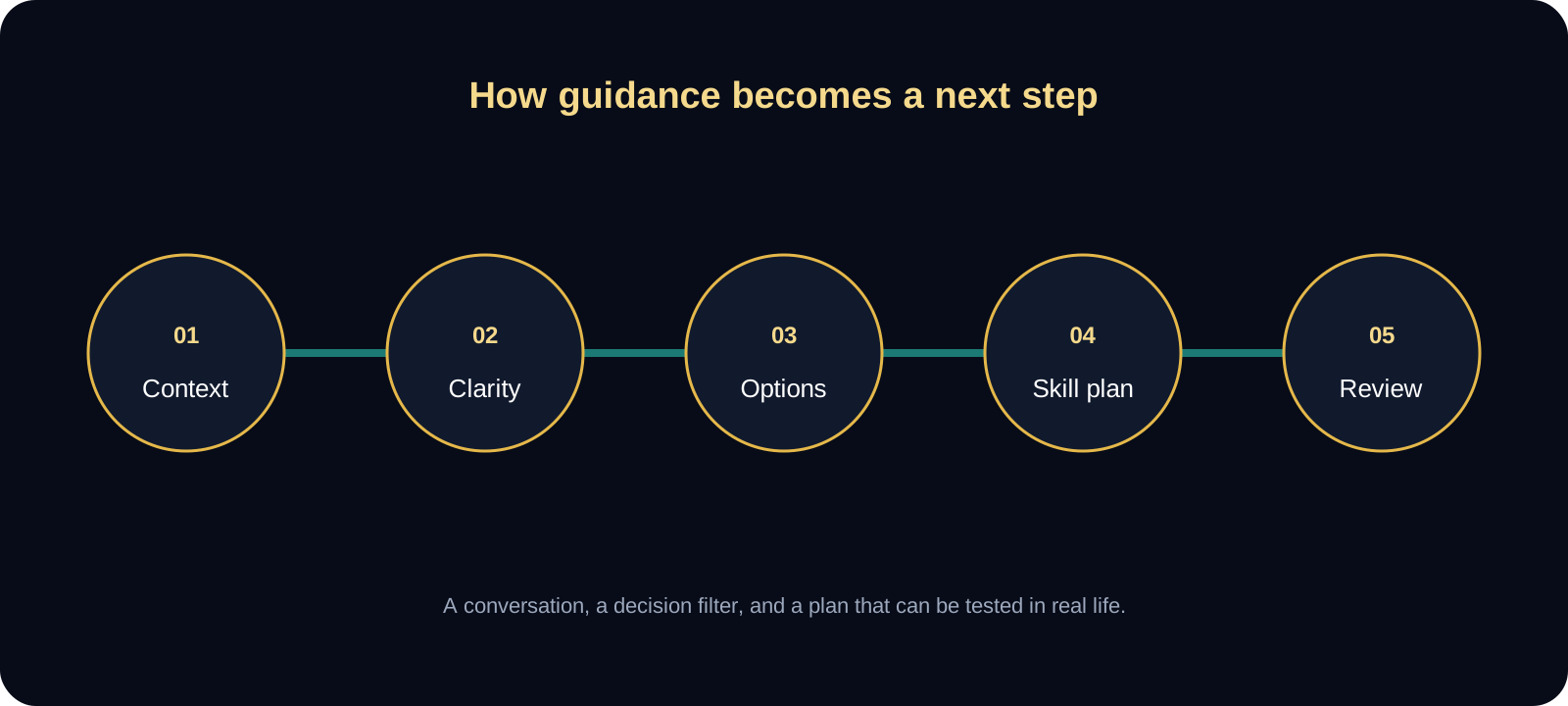
Five-stage career guidance session flow from context to review
A guidance session moves from context to clarity, options, a skill plan and review.
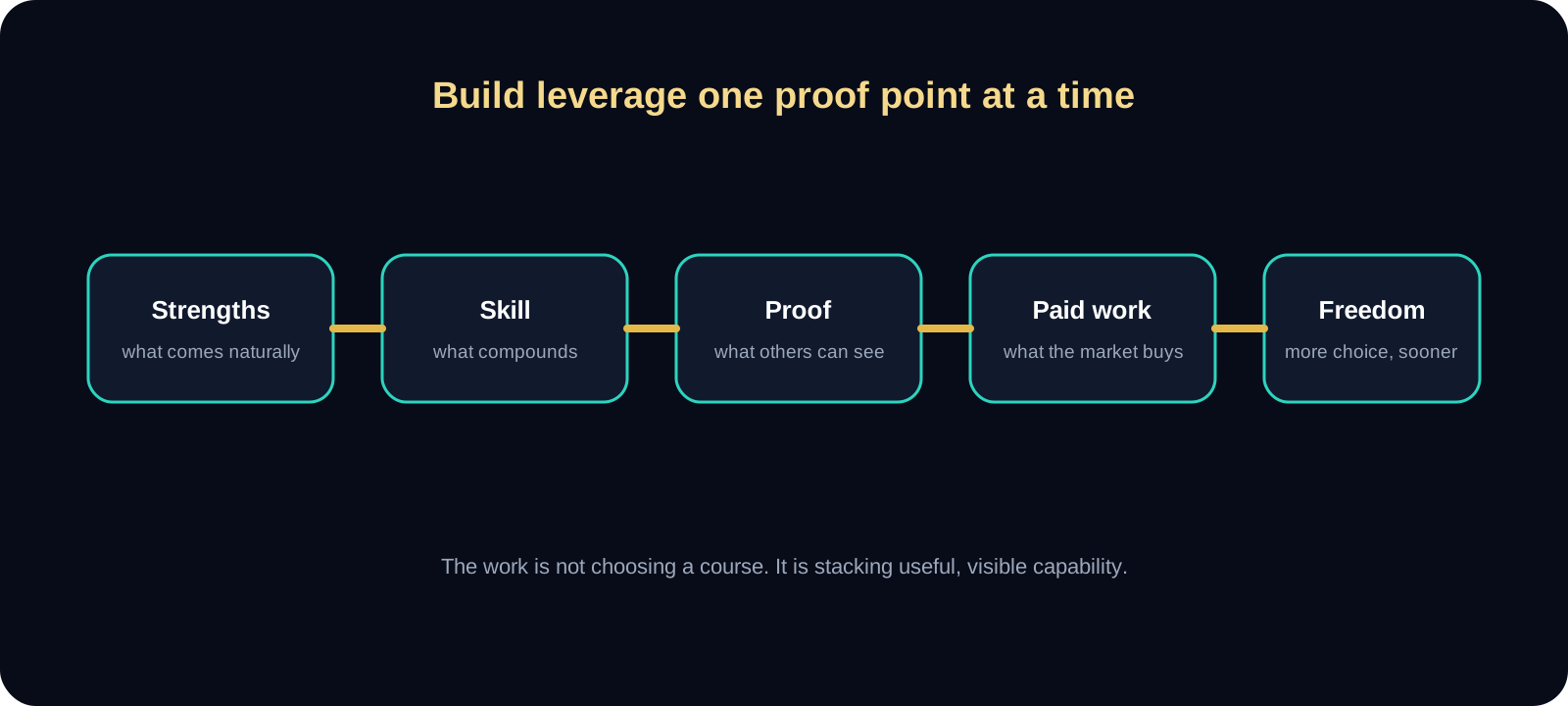
Skill portfolio chain from strengths to financial freedom
Strengths become skills, skills become visible proof, and proof leads to paid work and more freedom.
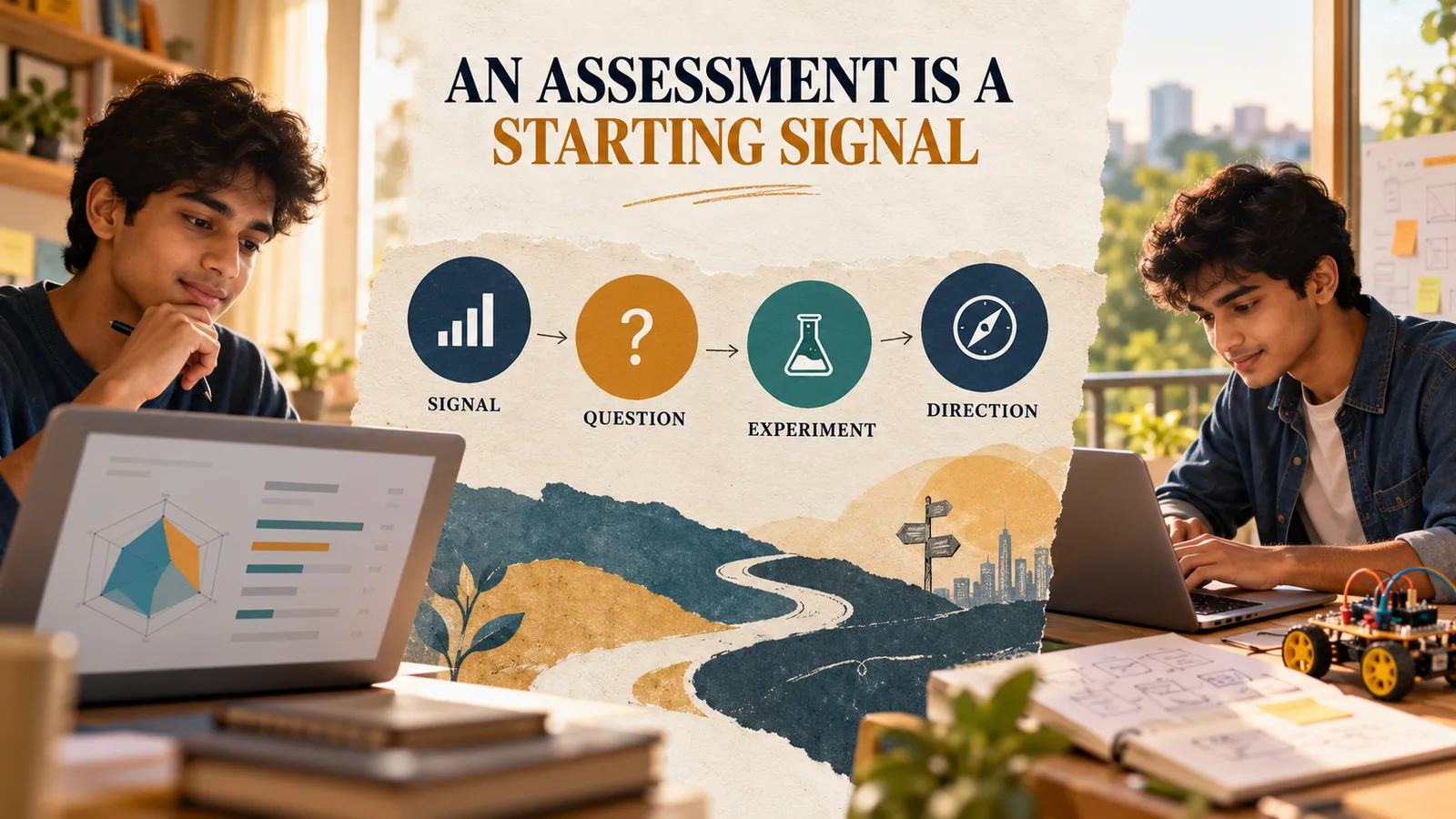
An assessment signal map showing how results become questions, experiments, and direction
Answer honestly

Rate each statement, then choose what you would do

There are no right answers on the statements, so think of your usual pattern, not your best day. In the situations, pick what you would really do, not what sounds best.

Which stage of life are you in?

Strain looks different for a student, a first-job employee, a senior professional and a self-employed person, so your report adjusts the advice to your stage.

It appears at the top of your result and in your PDF report. It stays on your device.
What is scored

Five areas of work and study life this self-assessment covers

Strain shows up in different places for different people. A higher score in an area means steadier everyday habits there. The area with the lowest score is a good place to start, and it is not a verdict about you.

Energy and exhaustion

How much is left in you through and after the day

High score: You usually have some energy left after the day, your days off help you recover, and you can stay with a task without your mind going flat.

Low score: You often feel emptied out early in the day, dread the start of it, or find that days off do not bring your energy back.

Interest and connection to the work or study

Whether the work or study still means something to you

High score: You can still find parts of your work or studies that interest you, you know why it matters, and you feel connected to the people around you.

Low score: Things feel flat or pointless, you do only the minimum, or you feel distant from colleagues and classmates.

Workload and control

Whether the load is clear, manageable and partly in your hands

High score: You know what matters most, you can ask for a different date when you are full, and you have some say in how you work or study.

Low score: The list never ends, priorities keep changing, or you feel you cannot say no or choose how to do things.

Rest, sleep and time off

How well you switch off and refill

High score: You sleep and eat at fairly regular times, you protect your off hours and leave, and you have something outside work or study that you enjoy.

Low score: Sleep and meals are the first things to go, work follows you into bed and days off, or leave days end up as working days.

People, boundaries and support

Who you can talk to and how you protect your time

High score: You have people you can be honest with, others know your available hours, and you can say when you are struggling.

Low score: You carry difficulties alone, say yes to everything, or find that work and study spill into every hour with no clear limits.

How to read your burnout self-assessment result

A higher score means steadier everyday habits

Statements are worded so that agreeing describes a steady pattern, such as having some energy left in the evening, knowing what matters this week or being able to talk to someone. Statements about strain are reversed, so saying they are not true for you raises your score.

The result answers one question: which area of your work or study life needs attention first. It does not say that you are or are not burnt out, and it cannot.

A low area is a pointer, not a label

A low score in an area means your answers there describe more strain or fewer supports at the moment. That is useful information about where a small change may help. It is not a judgement about your ability, your character or your future.

Start with one area and retake after a few weeks

Take the fourteen day routine for your lowest area and do only that. Then retake the self-assessment and compare area by area. One steady change usually works better than trying to fix everything together.

Your stage of life matters. Exam preparation, first jobs with targets, senior roles and self-employment each bring different loads, so your report adds advice for the stage you pick.

When a self-rating is not enough

A tool like this can only describe your own answers on one day. If you feel exhausted for weeks, cannot sleep or eat, feel hopeless, or cannot cope, please talk to a doctor, a counsellor or someone you trust. You can also call Tele-MANAS on 14416, a free national helpline.

Limits to keep in mind

  • This is not a diagnosis, a medical test or a mental-health assessment. It cannot tell you whether you have or do not have burnout or any other condition.
  • It is a self-rating of everyday habits and conditions, and it shows only how you describe your life today. A different week, a different exam period or a different project may give a different result.
  • If you feel unable to cope, are very low for weeks, or have thoughts of harming yourself, please see a doctor or a counsellor or speak to someone you trust. You can call Tele-MANAS on 14416, a free national helpline.
  • Scores are not compared with other people, so there is no pass mark. A high score does not mean everything is fine, and a low score does not mean something is wrong with you.
  • Advice here is general habit guidance. Some causes of strain, such as an unsafe or unfair workplace, are not solved by personal habits, and may need a conversation with a manager, HR, a union or a professional.
  • A score on one day is not a reason to leave a job or a course. Big decisions need more than a self-rating, and are better made after speaking to people who know your situation.
Common questions

Before you take the test

Is this burnout test free?

Yes. The test is free, takes about six minutes and needs no sign-up. You get scores for five areas, advice for your stage of life and a downloadable report.

Is this a medical or mental-health test, and can it tell me if I am burnt out?

No. It is not a diagnosis and not a medical or mental-health assessment, so it cannot say whether you are burnt out or have any other condition. It shows which area of your work or study life needs attention first. If you feel unable to cope, or have thoughts of harming yourself, please see a doctor or a counsellor or speak to someone you trust, and you can call Tele-MANAS on 14416, a free national helpline.

How is the score worked out?

Statements are rated from 1 to 5 and the ones about strain are reversed, so a higher score always means steadier everyday habits. In the situation questions each option carries a score from 0 to 100. Each area score is the average of its statements and situations, shown out of 100, and the overall score is the average of the five areas.

What is a good score on a work burnout quiz like this?

There is no pass mark. Scores are only against your own answers and are not compared with anyone else. Use them to see which of the five areas has the most room for a small change.

Can students use this as a student burnout test?

Yes. Choose the student stage, which covers school, college and exam preparation, and the statements and advice change to fit. The result still describes habits and conditions, and it does not diagnose anything.

Can freshers, managers and freelancers use it?

Yes. There are four stages: student, early career, experienced or managing others, and independent work such as freelancing, founders, small-business owners and people also running a home. Each stage gets its own statements and advice.

What is the difference between this and the exam stress or time management self-assessments?

The exam stress self-assessment looks at coping around exams. The time management self-assessment looks at planning and focus. This one looks at the wider balance of energy, interest, workload, rest and support across work or study life. They work well together.

Should I quit my job or course if my burnout self-assessment score is low?

No. A self-rating from one day is not enough to base a decision like that on. Use the score to pick one small habit to change, give it a few weeks, and talk to a manager, teacher, family member or counsellor before any big decision.

How often should I take this burnout self-assessment again?

Retake it after about three to four weeks of working on your lowest area, so that you can see whether anything has shifted. Taking it every day is not useful, since habits change slowly and one bad day can move a score.

What should I do if my score is low?

A low area score points to one place to start, not to something wrong with you. Follow the fourteen day routine for that area and retake the test after a few weeks. If you feel heavy for many days, talk to a doctor, a counsellor or someone you trust.

Free results are step one

Free assessment results are useful. Real career decisions need stronger guidance.

Start with the free test that fits your stage. When the decision gets serious, move to updated career guidance that turns those signals into better choices, stronger skills, and higher leverage.

Use free results to narrow the problem before you commit to a bigger decision.

Use guidance to avoid wasted years, wasted money, and low-value skill choices.

Use the right plan for your stage to turn the result into a practical next step.

Sessions are online across India. The stronger plan gets built inside the guidance service.

Career Guidance Pricing

Students

Student path

Student Career Guidance

Practical student career guidance before the wrong path wastes years, money, and future readiness.

Limited-time student offer
₹3000
₹250
for the first 1-on-1 session

A low-friction first step before the wrong path costs more time and money.

Online across India

Avoid

Wrong streams, outdated degrees, and low-value skills that waste years and money.

Move toward

Useful skills, future readiness, and a clearer next decision.

Working Professionals

1-on-1

Working Professional Career Guidance

For professionals who need clearer pivots, stronger compensation, and higher-leverage career moves.

Limited-time professional offer
₹5000
₹3000
for one 1-on-1 session

Book one sharp 1-on-1 before stagnation, weak positioning, or a bad pivot gets more expensive.

Online across India

Avoid

Salary ceilings, random upskilling, weak positioning, and pivots that waste time and money.

Move toward

More useful skills, sharper positioning, and clearer next moves.