 By Allu Vagdevi - Career researcher and writer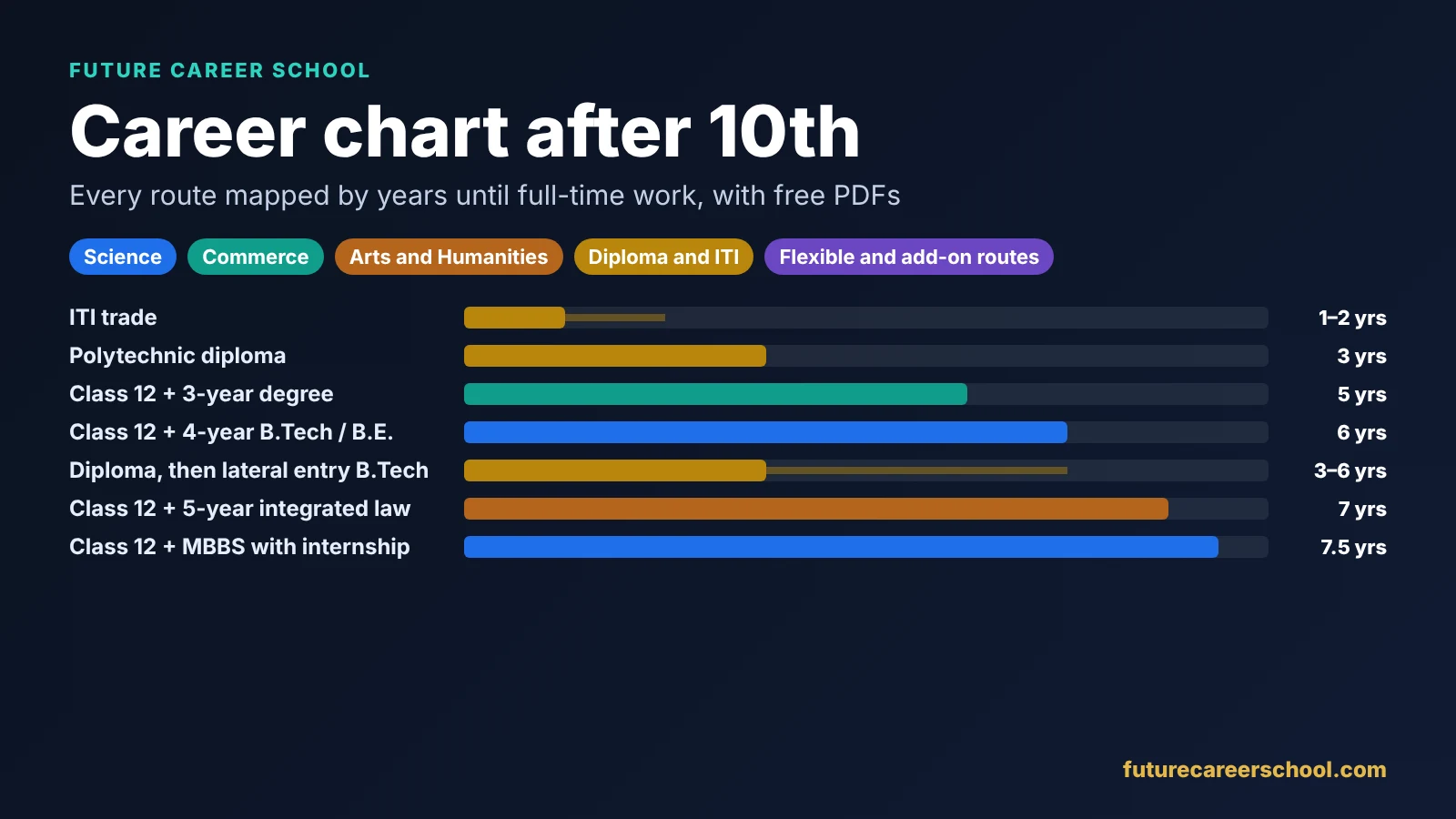
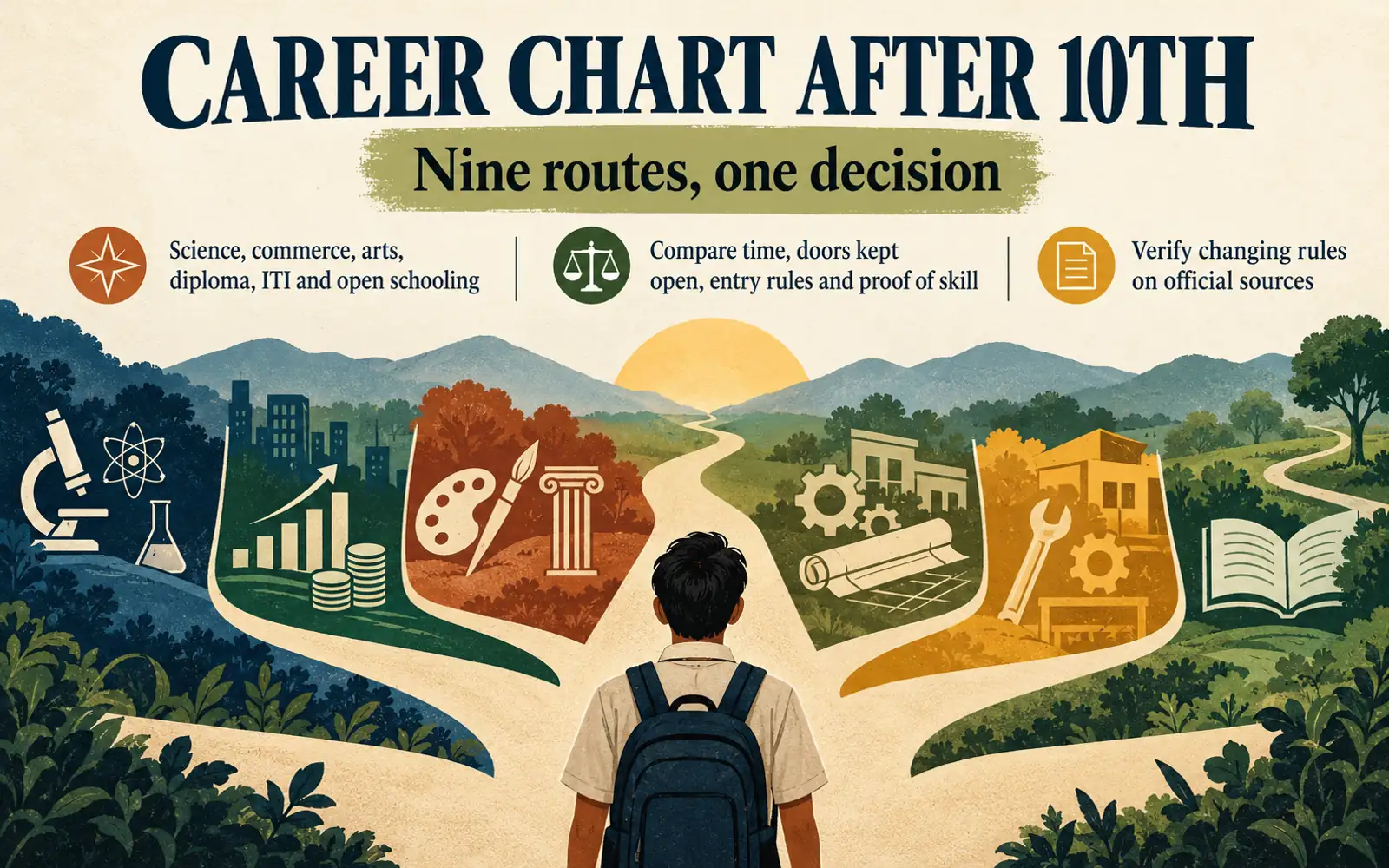
A career chart after 10th maps every route open to you, from science, commerce and arts to diploma, ITI and open schooling, and shows how long each takes and which doors it keeps open. This page gives you that chart to follow on screen and to download as a free PDF. Use it to find the route you lean toward, then build a skill portfolio on top of it, because that is what moves you toward stronger income and earlier financial freedom. The route opens the door. Proof of skill decides what happens after it.
The short version
- There are nine routes after Class 10, plus a skill layer that runs beside any of them. Each route has a length, an entry rule, a list of doors it keeps open and a list it closes.
- Work-first routes (ITI and diploma) reach full-time work in 1 to 3 years. Class 12 plus a degree takes 5 years or more, and medicine about 7.5.
- Maths and Biology can be dropped later but not added, so that choice is the hardest one to reverse.
- Rules change by state, board and year. Use the chart to ask better questions, then confirm each rule on the official site.
- Run the route you lean toward through The 4-Checkpoint Protocol and The 3 Gates, then build a skill portfolio inside it. That combination decides your income ceiling more than the route label.
For a slower written walk-through of the same decision, read career options after 10th. When Class 12 nears, the career chart after 12th covers entry exams, seats and costs.
Your personal route finder: which route fits you best?
Answer a few questions and the finder ranks the routes in this chart for you, shows how many doors each keeps open, what each costs in exam pressure and money, and gives you a 30-day experiment for your top two. Choose student if you are choosing for yourself, or parent if you are helping your child.
Your answers stay in this browser. The result is a starting point for a family conversation, not a decision.
Download the career chart after 10th as a PDF
The career chart after 10th PDF download is free, opens straight away and needs no sign-up. Print it, put it on the wall and use a pen on it. The all-routes file carries a one-page plan to fill in.
The career chart after 10th: follow the route that fits you
Start at the top question and follow the answers down. Each coloured end point is a route. Tap it to jump to that route's full card further down the page.
- Yes, soonWhich kind of work do you enjoy more?
- Using tools and fixing things by handITI trade course1 to 2 years to work
- Drawings, circuits, machines and systemsPolytechnic diploma3 years to work
- Still not sureSkill-first stack beside school1 to 3 years to work
- Not that soonWhich subject do you go back to when nobody is checking?
- Maths and PhysicsScience with Maths (PCM)5 to 6 years to work
- Biology and living thingsScience with Biology (PCB)5 to 7.5 years to work
- Money, markets and businessCan you work through Maths for two more years?
- YesCommerce with Maths5 years to work
- No, I would struggleCommerce without Maths5 years to work
- People, language, society or designArts and Humanities5 to 7 years to work
- I like both Maths and BiologyScience with both (PCMB)5 to 7.5 years to work
- I cannot attend regular schoolOpen schooling (NIOS and state open schools)2 to 3 years to work
This flow gives a first lean, not a verdict. Test the route it points to with the checks below before you commit.
How many years until full-time work on each route
Time is the one number the usual lists leave out. This chart counts from the day Class 10 ends to the earliest standard start of full-time work. A lighter extension means there is a second stopping point further along the same route.
Years counted from the day Class 10 ends to the earliest standard full-time start. They show time, not pay. Postgraduate study, repeat attempts and licensing exams add years in some routes.
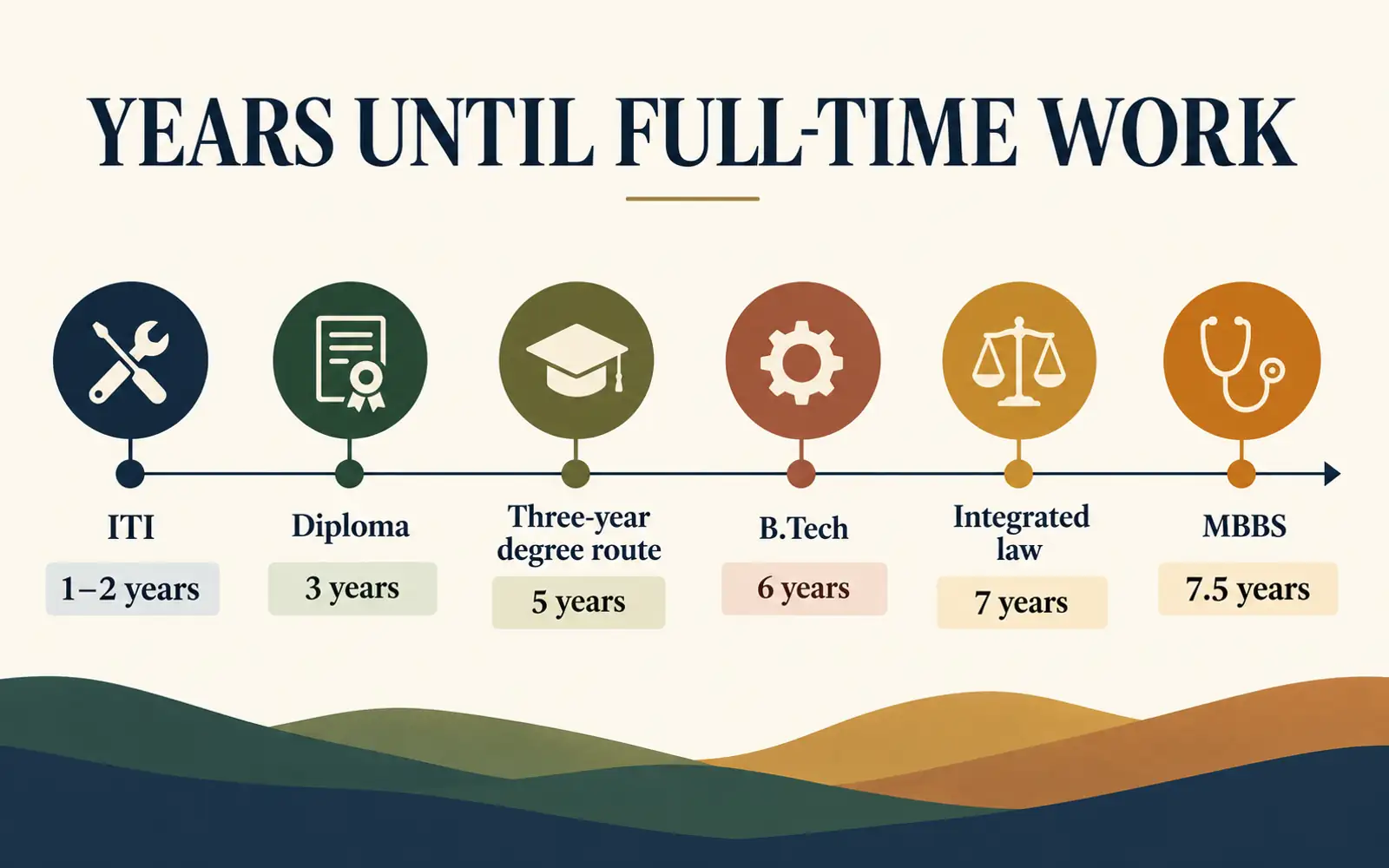
A shorter route is not a better route. A diploma holder who stops learning can earn less than a degree holder with strong proof of work, and the reverse is just as common. The point of the chart is to see the trade-off in years, then decide what you can sustain.
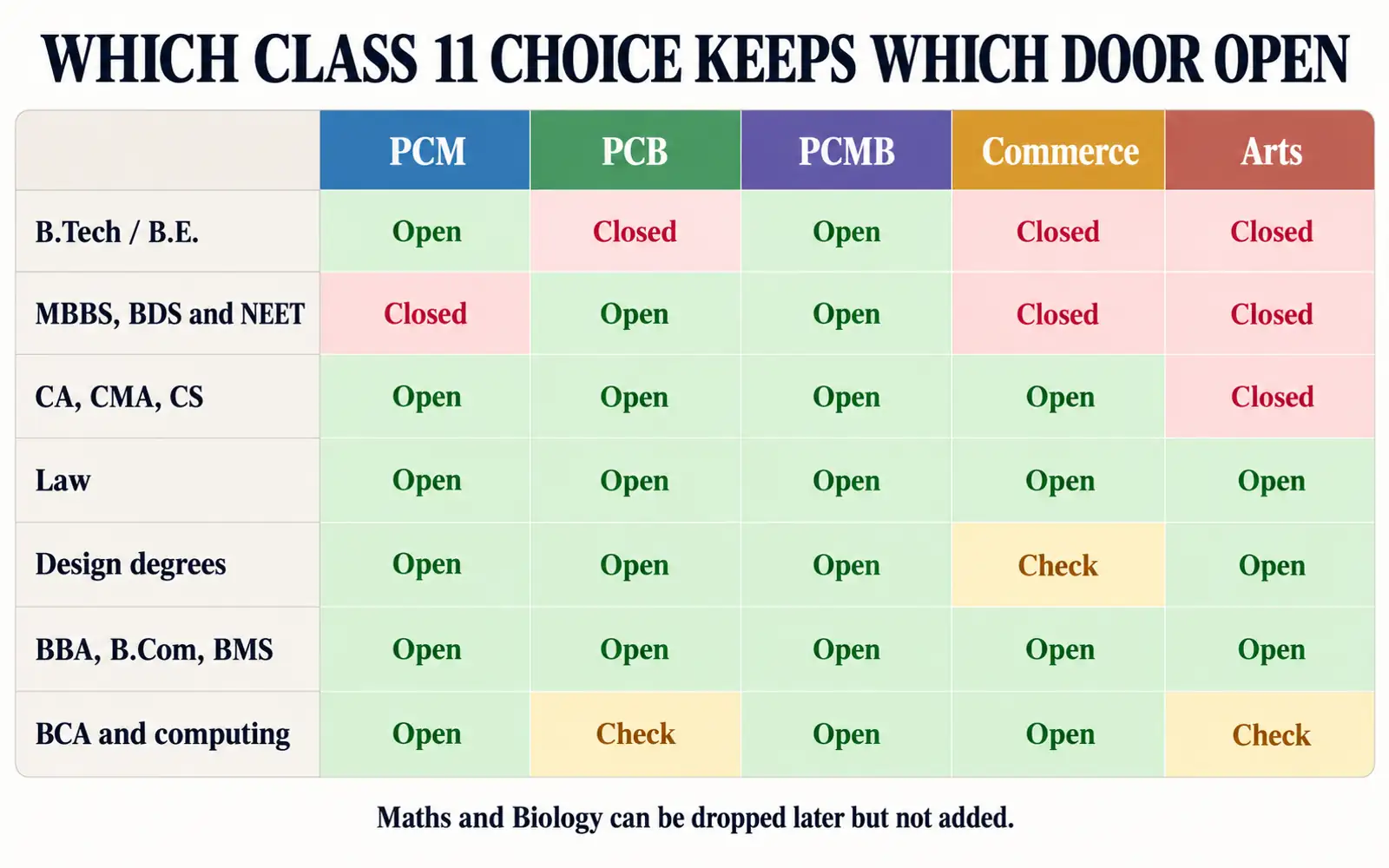
Which Class 11 choice keeps which door open
This is the part of a career guidance chart after 10th that families check last and should check first. Read across a row to see which choices keep a later door open.
How we rate scalability
We rate a route Scalable when steady learning and a whole-picture approach (skills, proof of work, communication and basic business, sales and marketing sense) can grow your income and reach into consulting or a business of your own. A route marked Scalable with a business layer is also a good option for us, as long as you plan that layer: consulting, a studio, a practice or a product. Crowded fields, long ladders of entrance exams and ranks, and careers where very few people reach the top after many years do not count as scalable, so we mark them Not so scalable and list the risk beside them.
Well-known routes such as MBBS and BDS, NDA, government exams, integrated law, pilot training, merchant navy and pure research stay in the chart so you can see what they carry, but they are rated Not so scalable. Success there depends on beating rivals at stage after stage, many years pass before pay grows, and few people reach the top. Consistent effort alone does not guarantee a result. If you choose one, write a second route and keep a skill running that can grow on its own.
| Later door | PCM | PCB | PCMB | Commerce | Arts | Diploma | ITI | Why | Scalability |
|---|---|---|---|---|---|---|---|---|---|
| B.Tech / B.E. degree | ✓ | ✕ | ✓ | ✕ | ✕ | Check | ✕ | Needs Maths in Class 12. A diploma can lead to second-year lateral entry; verify the state and college. | Scalable with a business layer. Crowded as a degree alone; scales with product, automation or AI skills. |
| MBBS, BDS and NEET medical seats | ✕ | ✓ | ✓ | ✕ | ✕ | ✕ | ✕ | Needs Biology in Class 12 with NEET UG. | Not so scalable. Competition at several levels (NEET, postgraduate seats, practice) with few seats; effort alone may not lead to a seat. |
| CA, CMA, CS professional courses | ✓ | ✓ | ✓ | ✓ | ✓ | Check | Check | Open to every stream after Class 12; commerce subjects make the first exams easier. | Scalable with a business layer. A practice can grow into advisory work, but the exam ladder is long and crowded. |
| Law (integrated 5-year) | ✓ | ✓ | ✓ | ✓ | ✓ | Check | Check | Entry tests such as CLAT and CUET take students from any stream after Class 12. | Not so scalable. Entrance competition, then a slow climb where few reach the top. |
| Design degrees | ✓ | ✓ | ✓ | ✓ | ✓ | Check | Check | Design entrance tests usually accept any stream; the portfolio carries the weight. | Scalable. Portfolio and skill decide pay; freelance and studio paths are open. |
| BBA, B.Com, BMS | ✓ | ✓ | ✓ | ✓ | ✓ | Check | Check | Most accept any stream; some want Maths or Accountancy. Check each college. | Scalable with a business layer. A general degree is crowded, but it is a natural base for a venture or consulting practice with a domain skill. |
| BCA and computing degrees | ✓ | Check | ✓ | Check | Check | Check | ✕ | Many colleges ask for Maths or Computer subjects in Class 12. Read the rule on each admission page. | Scalable. Skills sell directly as software, data and automation work. |
| NDA (Air Force and Navy wings) | ✓ | ✕ | ✓ | ✕ | ✕ | ✕ | ✕ | Needs Physics and Maths in Class 12. The Army wing accepts other streams; check the current notice. | Not so scalable. A very small intake and strict standards; most applicants do not get in. |
| Civil services and many government exams | ✓ | ✓ | ✓ | ✓ | ✓ | Check | Check | These ask for a degree in any subject, so no stream closes them. Diploma and ITI holders need to add a degree first. | Not so scalable. Very large numbers for few posts, with repeated attempts; keep a parallel skill. |
✓ means the standard rule keeps the door open. ✕ means it closes it. Check means it depends on the course, college or state. Diploma and ITI columns assume no Class 12 is completed yet; open schooling can add Class 12 later.
The pattern is simple. Biology can only be dropped, never added later, and so can Maths. Commerce and arts keep most professional and degree doors open, but they close engineering and medicine.
If you are unsure, the useful question is not which stream is safest. It is which door you would hate to find closed in two years.
Career chart after 10th for science: PCM, PCB and PCMB
Science is the widest gateway to technical and medical degrees, and the one with the heaviest school load. Take it when you want one of those degrees or genuinely enjoy the subjects, not because the label sounds safe.
Science with Maths (PCM)
Entry
Class 10 pass. Many schools set their own minimum in Maths and Science for this group, so ask the school before you count on a seat.
Best for
Students who enjoy solving problems step by step, can sit with Maths and Physics for two years, and want engineering, computing or research left open.
Watch out
Taking PCM because everyone else did. A weak Maths base shows up in Class 11 within a term, and two drifting years are expensive.
Scalability
Scalable with a business layer. The doors it opens (engineering, computing, data) can grow into products and consulting, but the engineering entrance ladder is crowded and a branch degree alone is not scalable. To grow: Add coding, automation or AI skills and build one project people use.
What it keeps open
- B.Tech / B.E. (4 years) through JEE Main, state engineering entrance tests, BITSAT and similar
- B.Sc in Physics, Chemistry, Maths, Statistics, Computer Science and data subjects
- BCA and other computing degrees
- Architecture (needs Maths, plus the architecture aptitude test)
- NDA: the Air Force and Navy wings need Physics and Maths in Class 12
What it closes
- MBBS, BDS and other NEET-based medical courses (these need Biology)
First move this month
Solve a full chapter of Class 11 Maths and Physics on your own and note where you got stuck and where you wanted to keep going.
Science with Biology (PCB)
Entry
Class 10 pass. Many schools set their own minimum in Science for this group.
Best for
Students who are drawn to the human body, plants, animals or lab work, and who accept that medicine is a long road with few seats.
Watch out
Treating NEET as the only reason to take Biology. MBBS seats are scarce, so write a second route (allied health, life sciences, pharmacy) before results, not after.
Scalability
Not so scalable. Its best-known doors (MBBS, BDS) mean competition at several levels and very few seats, so effort alone may not lead to a seat. The scalable doors are biotech, health-tech, nutrition and data. To grow: Write a second route, and add a data, health-tech or science-communication skill beside Biology.
What it keeps open
- MBBS, BDS and other medical seats through NEET UG
- B.Sc Nursing, physiotherapy, medical lab and other allied health courses (entry route differs by state; verify)
- B.Pharm and pharmacy routes (verify whether your state accepts PCB or needs Maths)
- B.Sc in life sciences, biotechnology, microbiology, agriculture and veterinary routes (check the entrance test)
What it closes
- B.Tech / B.E. (these need Maths in Class 12)
First move this month
Spend one day with a nurse, lab technician, pharmacist or doctor you can reach through family or school, and list the tasks they actually did.
Science with both (PCMB)
Entry
Class 10 pass. Not every school offers the combination, and the load is the heaviest of all.
Best for
Students who are genuinely strong in both Maths and Biology and are still undecided between engineering and medicine.
Watch out
Picking it to avoid a decision. Five heavy subjects often lower scores in all of them, which weakens both doors.
Scalability
Scalable with a business layer. It keeps the widest set of doors, but only the computing, data and biotech doors scale. Two heavy exam tracks at once can leave little time to build skills. To grow: Choose one primary track early and keep one skill project running.
What it keeps open
- Keeps both the engineering and the medical doors open until Class 12 ends
First move this month
Check last year’s school results for the PCMB group and ask how many students scored well in both Maths and Biology.
If the choice is still blurred, the stream selector test after 10th turns your interests and strengths into a ranked lean. The guide to choosing a stream in 11th goes deeper on subject combinations.
Career chart after 10th for commerce: with and without Maths
Commerce is the stream for business, money, accounting and markets. The decision that matters inside it is Maths, because it decides how many quantitative doors stay open.
Commerce with Maths
Entry
Class 10 pass. Maths in Class 10 helps; some schools ask for a minimum.
Best for
Students who like money, markets, numbers, how businesses make profit, or who come from a family business and want to run it better.
Watch out
Choosing commerce as an easy stream. Accountancy and Economics reward steady practice, and a degree without any applied skill leads to the lowest-paid desk jobs.
Scalability
Scalable with a business layer. Opens BCA, data, finance and business routes that scale, but CA and general management degrees are crowded unless you add a niche. To grow: Learn spreadsheets, data and sales, and try a small real venture.
What it keeps open
- B.Com, BBA, BMS, economics and statistics degrees
- CA, CMA and CS professional ladders (ICAI has allowed provisional CA Foundation registration after Class 10, and the exam needs Class 12 appearance; confirm the current rule)
- Finance, analytics and actuarial-style routes that need Maths
- Integrated law (BBA LLB) and management routes through CUET or CLAT
What it closes
- B.Tech / B.E. and NEET medical routes
First move this month
Read one company’s annual report summary or a small shop’s monthly accounts and write what makes its profit rise and fall.
Commerce without Maths
Entry
Class 10 pass.
Best for
Students who want business or accounting but are sure Maths will not carry them for two more years.
Watch out
Dropping Maths without checking the programmes you may want later. Some doors can be reopened with bridge courses, but it costs time.
Scalability
Scalable with a business layer. Business, finance and communication routes scale when you add a domain skill; a general degree alone is crowded. To grow: Pair the degree with one applied skill: sales, accounting software, marketing or modelling.
What it keeps open
- B.Com, BBA, BMS and most business and accounting degrees
- CA, CMA and CS routes
- Integrated law and CUET-based BA and B.Com courses
What it closes
- Quantitative economics honours and some analytics or actuarial programmes that ask for Class 12 Maths
- B.Tech / B.E. and NEET medical routes
First move this month
List three degrees you might want after Class 12 and check each one’s Class 12 subject rule on its own admission page.
Career chart after 10th for arts and humanities
Arts is the most misread stream. Law, psychology, design, media, teaching and civil services all start from it. The risk is not the stream. It is finishing the degree with nothing to show.
Arts and Humanities
Entry
Class 10 pass. Available in most schools; subject combinations vary by school.
Best for
Students who read, write, argue, observe people, design or create, and who are ready to build proof of work instead of waiting for a job title.
Watch out
Finishing the degree with no visible work. Arts degrees pay when they are paired with a portfolio, writing samples, a research brief or a communication skill.
Scalability
Scalable with a business layer. Design, media, psychology and communication scale when you own an audience, a portfolio or a practice. Law and civil services are crowded ladders with few winners. To grow: Build a portfolio or writing proof early and choose a niche.
What it keeps open
- Law (5-year integrated BA LLB through CLAT or CUET-based seats)
- Psychology, sociology, economics, political science, journalism and mass communication degrees
- Design and creative degrees through design entrance tests (NID, NIFT, UCEED and others)
- Teaching (integrated B.Ed routes and the teaching degree path)
- Hotel management (NCHM JEE) and many CUET-based BA courses
- Civil services and many government exams, which accept a degree in any subject
What it closes
- B.Tech / B.E. and NEET medical routes
First move this month
Make one finished piece this month: a two-page explainer, a short design, a recorded talk or a small research note on a topic you chose.
Career chart after 10th for diploma, ITI and open schooling
These routes start technical learning or earning sooner, or let you finish school on your own schedule. They work when the institute is verified and when skills keep being added after the certificate.
Polytechnic diploma
Entry
Class 10 pass. Admission is usually through the state technical education board by merit or an entrance test, so rules and cut-offs differ by state.
Best for
Students who learn best through labs, drawings, machines and systems, want to earn earlier, and are willing to check the institute before joining.
Watch out
Joining the nearest institute without checking approval, labs, faculty and what its own students did after passing. The label is the same, the quality is not.
Scalability
Scalable with a business layer. A diploma alone has a fixed pay ladder. It scales when you add digital, automation or supervision skills, or run your own technical service. To grow: Use lateral entry or a skill project to move up, and learn automation.
What it keeps open
- Junior engineer, technician, supervisor and site roles after the diploma
- Lateral entry into the second year of B.E. / B.Tech after a diploma (verify the state rules and the college)
- Apprenticeship training through NATS
- Self-employment in services such as electrical, networking and repair work
What it closes
- NEET medical routes. The Class 12 science subjects are not studied, so check how a diploma is treated for the degree you want.
First move this month
Visit the institute’s lab on a working day, ask for last year’s placement or lateral-entry list, and confirm approval on the official regulator site.
ITI trade course
Entry
Minimum education depends on the trade: some accept Class 8 pass, many need Class 10. Admission is usually through the state, so verify the trade’s own rule.
Best for
Students who learn faster by doing than by sitting through theory, want the shortest gap to a skilled job, and are ready to keep adding skills.
Watch out
Stopping at the certificate. The trade is the base; communication, digital skill, safety knowledge and a record of finished work decide how far it grows.
Scalability
Scalable with a business layer. Trade pay starts low. It scales when you run your own service business (repair, installation, solar, electrical work) and add digital or safety skills. To grow: Take an apprenticeship, then offer your trade as a service.
What it keeps open
- Skilled trade jobs and supervised work in industry
- Apprenticeship training through the Apprenticeship portals
- Some states and institutes allow ITI holders to join a diploma in the second year (verify)
- Self-employment as an electrician, technician, mechanic or plumber
What it closes
- A direct route to degree seats unless you add Class 12 (open schooling) or a diploma bridge
First move this month
Visit a local workshop for the trade you like, watch a working day, and ask the owner what separates a well-paid worker from a poorly paid one.
Open schooling (NIOS and state open schools)
Entry
Class 10 pass from a recognised board and a minimum age of 15 (NIOS prospectus rules; confirm the current prospectus). At least five subjects must be passed, with one or two languages.
Best for
Students who must earn, travel for training or sport, have health reasons, or are returning to study after a break.
Watch out
Treating it as a lesser route. It needs more self-discipline than a regular school, because nobody checks your daily progress.
Scalability
Scalable with a business layer. It gives time to build skills, and scales only if you use that time for real proof of work. To grow: Use the time to build one skill and one finished project.
What it keeps open
- Completing Class 12 while working, training for a trade, or preparing for sport or arts
- A route back to degree courses for students who left school, started an ITI, or did a diploma first
- Subject combinations not offered in a nearby school
What it closes
- Nothing by itself. NIOS states its certificate is equivalent to other boards and accepted by universities, but some institutions set their own rules, so confirm for your course and subject group.
First move this month
Download the current prospectus from the official site and read the subject groups and the exam-session rules before you decide.
Skill-first stack beside school
Entry
No entry gate. A phone or computer, internet access and finished work are enough to begin.
Best for
Every student. This is the layer that raises the income ceiling of whichever route you pick.
Watch out
Collecting certificates. A certificate without a finished piece of work is easy to copy and easy for a reviewer to ignore.
Scalability
Scalable. You control the pace. A digital or craft skill with proof of work can be sold directly and can grow into consulting or a business. To grow: Pick one skill, build three pieces of proof, then take paid projects.
What it keeps open
- Proof of work (projects, drafts, small client tasks) that a mark sheet cannot show
- Entry into skill-based roles after the route you choose
- Earlier income options through freelance or part-time tasks, within your family’s and the law’s limits on work at your age
First move this month
Choose one skill that matches your route and finish one small, real piece of work with it, then show it to one person who does that work.
The Directorate General of Training's Craftsmen Training Scheme page lists 14,643 ITIs and 169 trades under the national skills framework (checked October 2026). The trade you choose matters less than your willingness to keep adding skills on top of it. For trade-by-trade detail, see the ITI section of career options after 10th.
What changes by state and board, and what to ask
A chart can show the national pattern. It cannot replace your own state's rules. Before you rely on any row, ask these questions, in writing where you can.
- Which subject groups does the school actually offer? Not every school runs PCMB, commerce with Maths or a given arts combination, and many set their own minimum marks.
- How is the diploma or ITI seat filled? Usually through the state technical education board or the state skill department, by merit or a test. Dates and cut-offs differ every year.
- Is the institute approved, and what is the total fee? Ask for the approval proof and the full fee list before paying anything.
- What did last year's students do next? Ask for the number who found work, joined apprenticeship training or took lateral entry.
- Does the degree you may want accept this certificate? This matters most for open schooling and for lateral entry, where rules sit with the state and the college.
Two state examples of how the same route differs
Andhra Pradesh, diploma route. Polytechnic diploma seats are filled through AP POLYCET, held in April in recent years. Published eligibility asks for a pass in the state SSC exam or an equivalent, with Mathematics as a main subject and a minimum mark set by the board, and seats are then allotted by rank, category and availability in counselling. If you are in Andhra Pradesh and Maths was weak, check this before treating a diploma as an easy exit.
Kerala, Class 11. Admission to government and aided higher secondary schools runs through a single centralised online process called HSCAP. You list your preferred schools and subject groups in one application, and seats are allotted mainly on Class 10 results and reservation rules, in rounds with supplementary lists. CBSE students who want a group with Mathematics need Mathematics-Standard, not Basic. A school in your first preference may not offer the combination you want, so list the combinations as carefully as the schools.
Dates, minimum marks and rules change every year. Confirm them on the state portals (the AP POLYCET site and hscap.kerala.gov.in) before you plan around them.
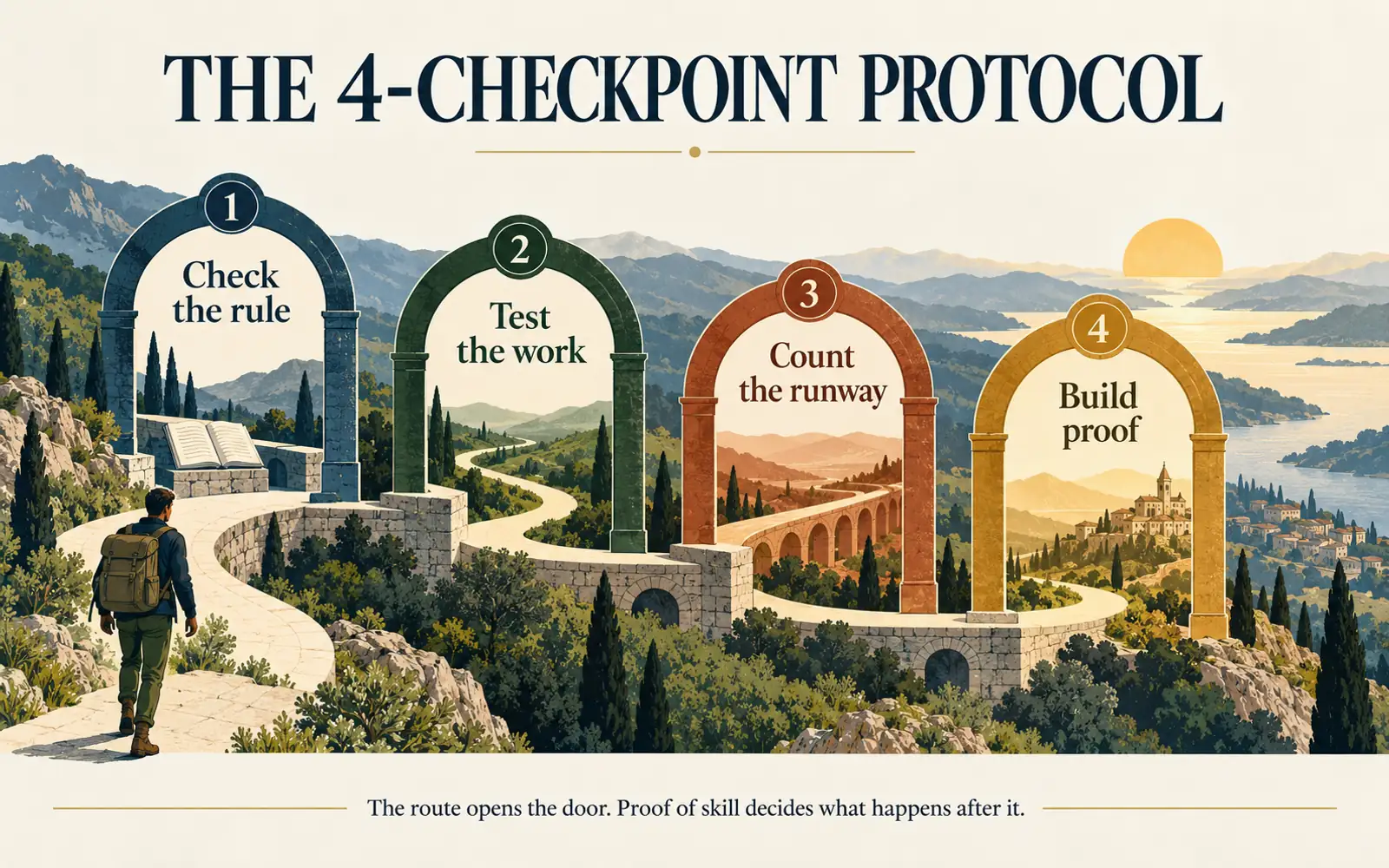
Test the route you lean toward before you commit
The chart gives a first lean. These checks turn it into a decision you can defend. Use the same four checkpoints on every serious option.
Biology
How do you actually work best: abstract study, business thinking, people, or tools and systems? Choose the daily reality, not the label.
Context
Marks, money, family situation, school options, commute and emotional readiness. A route right on paper can be wrong for now.
Market
Where does the route lead later: real roles, real skills, real progression? Map it forward before you choose.
Survival
Will it hold up in an AI-shaped market? Domain skill plus communication, digital fluency and judgment lasts longer than routine work.
Then pass The 3 Gates before the decision gets expensive.
Proof of Skill
Complete one small real task that resembles the route before you lock it.
Proof of Communication
Explain in 30 to 90 seconds why the route fits you, where it leads and what you will test next.
Proof of Value
Get grounded feedback from a teacher, senior or professional who does this work, and pressure-test your reasoning.
Five mistakes families make with a career chart
- Choosing by marks alone. High marks tell you what you can enter, not what you can sustain for two to five years.
- Copying friends or relatives. The route that worked for a cousin worked for their strengths, money and city.
- Dropping Maths or Biology without checking. Maths is needed for B.Tech and Biology for NEET medical seats. Check what you may want before you drop either.
- Paying before verifying. Check that the institute is approved, the fee is the total fee and the course is recognised.
- Treating the route as the whole plan. Every route leads to crowded and well-paid rows alike. The skill layer on top is what separates them.
If you are a parent reading this chart
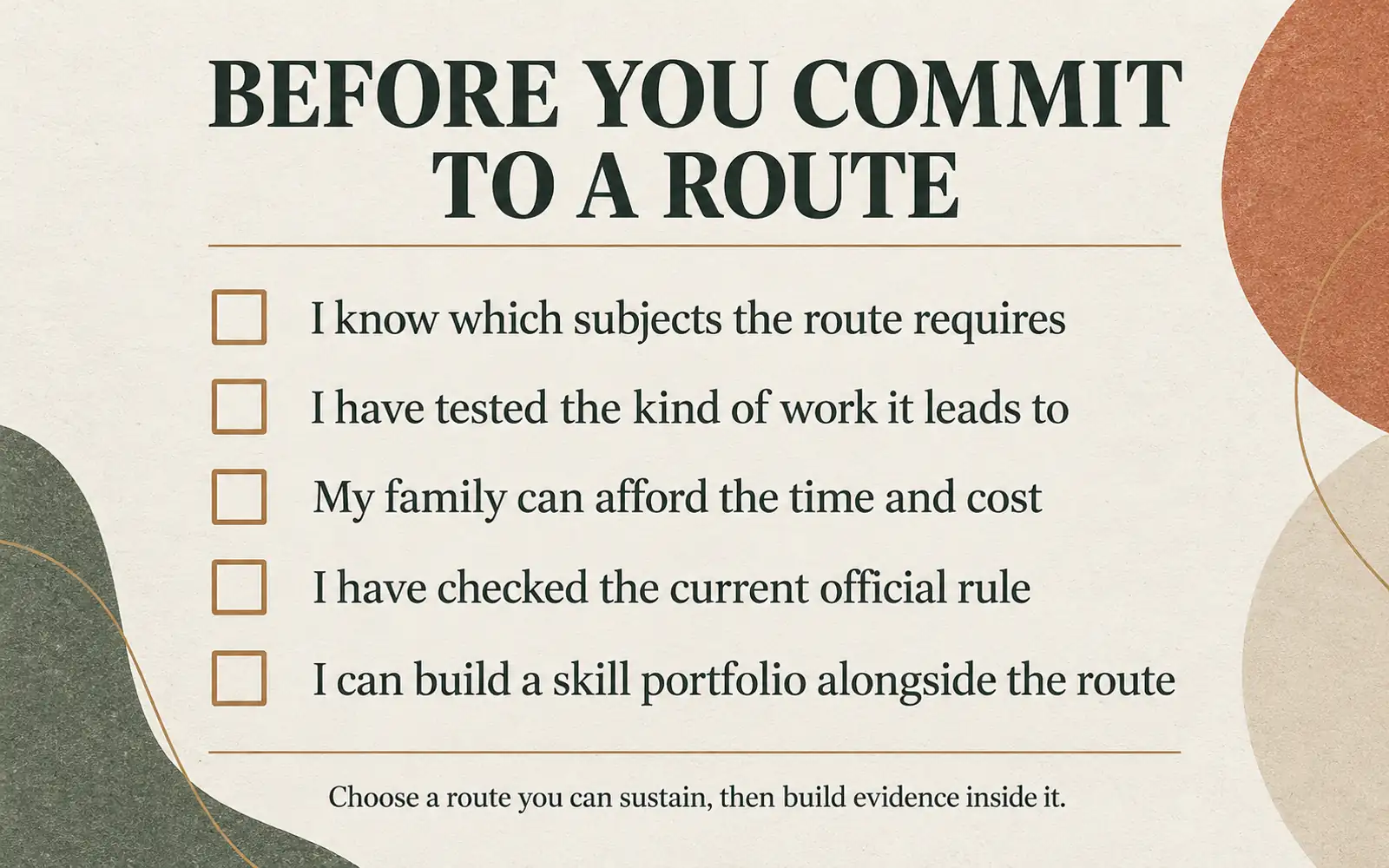
Your job is not to choose for your child. It is to improve the quality of the decision. Read the chart together, ask which door your child would hate to see closed, and compare the years and costs honestly.
- Ask what your child can finish this month, not only which college name sounds safe.
- Compare years to work and total cost across two routes before comparing prestige.
- Never pay a fee before the institute's approval and the total fee are in writing.
- A modest route with real proof of skill is safer than an expensive route with none.
What to do next
- Download the PDF for your stream and write the route you lean toward, and a second route you would accept, on the plan page.
- Check your lean. The free career assessment for Class 10 and below shows strengths and fit. If you feel stuck, the confused about career after 10th test shows what kind of stuck it is.
- Finish one small real task that resembles the route, then explain it to someone who does that work.
- Verify the rules for your state and the institute on the official sources below.
The route you choose is a base layer. The high-income skill portfolio you build on top of it raises your ceiling and moves you toward earlier financial freedom.
For continuous, structured help building that portfolio, get career guidance for you and your family rather than weighing opinions alone. You can start with a WhatsApp message from that page.
Also useful: the career aptitude test after 10th for a deeper strength profile.
Verify on the official source before you pay
| Source | Use it for |
|---|---|
| NIOS (open schooling) | Open-school Secondary and Senior Secondary, vocational courses, study centres. The site states that the Association of Indian Universities has issued equivalence for the NIOS Senior Secondary certificate. |
| DGT Craftsmen Training Scheme (ITI) | How the ITI network works. The page lists 14,643 ITIs and 169 NSQF-compliant trades (checked October 2026). |
| NATS (apprenticeship training) | Apprenticeship-style, learn-while-working training for diploma and technical graduates. |
| AICTE | Check that a diploma or engineering institute is approved before paying. |
| NTA (JEE Main, NEET UG, CUET UG) | Exam eligibility, syllabus and dates for the entrance tests that start after Class 12. |
Entry rules, minimum marks, fees and seat numbers differ by state, board and year. Treat this chart as a map for asking better questions, then confirm every rule on the official site before you pay or lock a subject. Last checked October 2026.
See diploma trades compared after 10th.
For the ITI route, read ITI career options.