How to choose a career after 12th: real plan
How to choose a career after 12th means choosing a path where you can build proof fast, afford the path safely, and stay useful in an AI-heavy market.
Are you scared of wasting years on the wrong degree?
Are you worried about college fees, loans, and low job outcomes?
Are you confused because every person gives a different answer?
Then do not start with college.
Start with the job, the market, the skill, and your reality.
If you remember only 5 points, remember these
The role decides the skills.
The degree is often only support.
Projects beat vague ambition.
Do not borrow before clarity.
Every career now has a tech layer.
If you want the broader framework category, open Career Guidance.
What most students do wrong after 12th
Common bad moves
- Choosing a course before choosing the actual job role.
- Copying friends, cousins, or social pressure.
- Taking a loan before proving interest and fit.
- Thinking a degree alone creates employability.
- Ignoring communication, tech, and AI skills.
- Staying invisible with no proof of work.
Better move
Choose a role.
Check its demand.
Check your fit.
Build one real project.
Then decide how much time and money that path deserves.
How to choose a career after 12th without wasting years
Use a decision scorecard.
Do not make a life decision from mood, marks, or pressure alone.
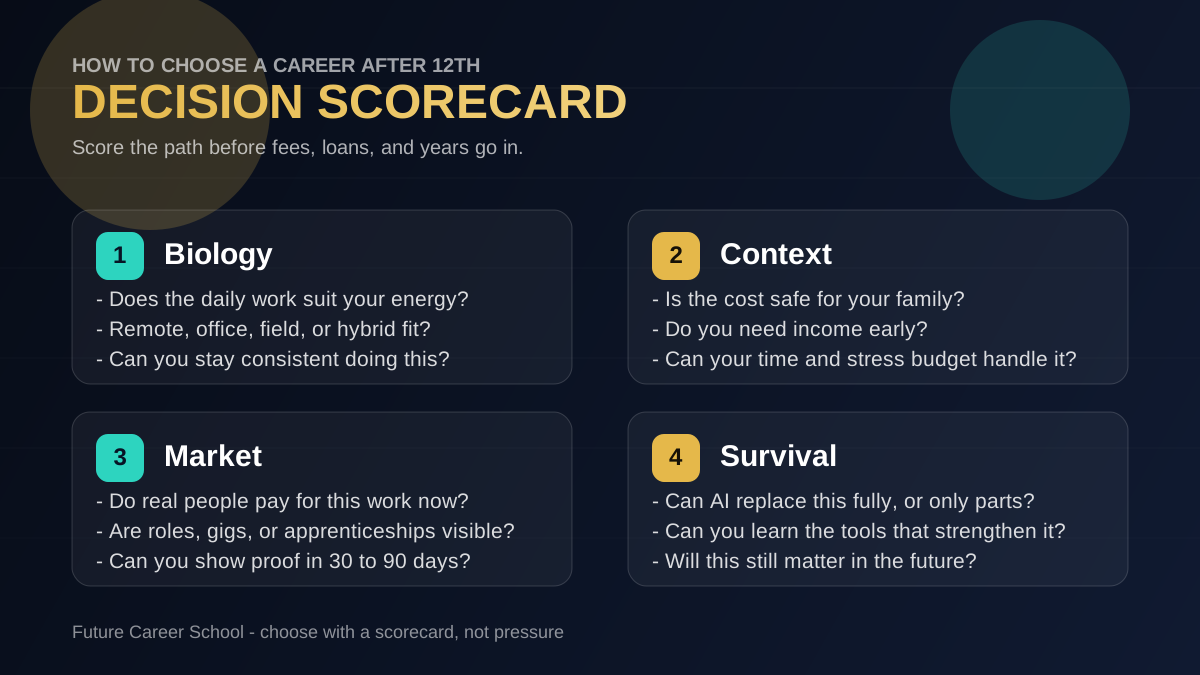
| Checkpoint | Question | What a good sign looks like |
|---|---|---|
| Biology | Does the daily work suit your energy style? | You can imagine doing the work without constant force. |
| Context | Does the path fit your money, time, and family reality? | The path is affordable and does not create panic. |
| Market | Do real people pay for this skill now? | Entry roles, internships, clients, or apprenticeships exist. |
| Survival | Can you stay valuable with AI in the loop? | You can use tools to become faster, not obsolete. |
Biology check
Do you like quiet deep work, people-heavy work, or field work?
Do you prefer remote, office, hybrid, or location-based work?
Your work style matters more than people admit.
Context check
Can your family handle the cost safely?
Do you need income early?
Time is more precious than money when the path is weak.
Market check
Is this solving a real pain that people or companies pay for?
Can you show useful proof in 30 to 90 days?
If not, be careful with long commitment.
Survival check
Can AI replace the whole job, or only part of the task?
Can you learn the tools that make the role stronger?
The safest roles are often human plus AI roles.
Sort careers into 3 lanes before choosing any course
This is one of the fastest ways to reduce confusion.
Not every career should be treated the same.
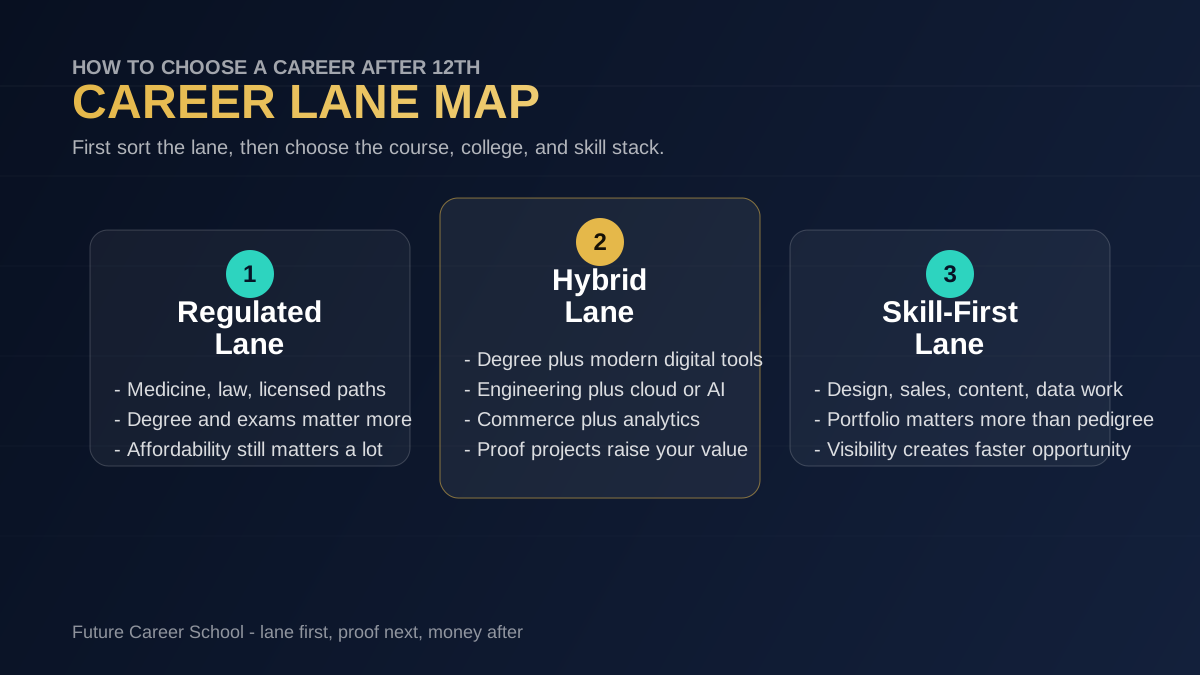
| Lane | Examples | What matters most |
|---|---|---|
| Regulated lane | Medicine, law, licensed professions, architecture | Formal route, licensing, exam path, affordability, stamina |
| Hybrid lane | Engineering plus cloud, commerce plus analytics, psychology plus UX research | Degree plus modern tools plus proof projects |
| Skill-first lane | Design, sales, digital marketing, content, data work, no-code building, freelancing | Portfolio, communication, market proof, visibility |
This one table alone can save people from years of confusion.
If your target is a regulated lane, degree matters more.
If your target is skill-first or hybrid, proof of work matters much more than most people think.
How to research a career path before you commit
Most people research colleges.
Very few research the actual job properly.
That is why many students stay confused even after joining a course.
Use this practical research checklist
- Read 20 to 30 job descriptions for the role you want.
- List the tools, skills, and keywords repeated most often.
- Check if internships, apprenticeships, or junior roles are visible.
- Look for real portfolios and case studies from people already in the role.
- Talk to three people who are closer to the work than you are.
- Try one small project before spending large money.
Good signal
You can clearly see what beginners are expected to know.
You can also see a realistic first step for yourself.
Bad signal
The role sounds attractive, but you cannot explain what real work happens each day.
That means more research is still needed.
Do not choose college before you choose the value you want to create
Many students ask which college to join.
A better question is this.
What kind of work do you want to get paid for?
The college ROI filter
- Can the total college cost stay in a safe part of your full learning budget?
- Can you do it without a loan?
- If a loan is needed, is repayment realistic from likely income?
- Will you still have money left for certifications, tools, projects, and safety?
- Does the course give real hands-on exposure or mostly theory?
- If placement support fails, can your skills still carry you?
A practical education-budget model
This is not a law.
It is a planning model.
The main point is simple.
Do not burn your full budget on a degree and then stay broke for the actual upskilling that creates outcomes.
How to use career assessments the right way
Assessments are useful.
But only if you use them as input, not as fate.
What assessments can do well
- Show your interest patterns.
- Show your work-style tendencies.
- Highlight strengths, blind spots, and personality signals.
- Reduce confusion between close options.
What assessments cannot do
- Guarantee the perfect career.
- Replace market research.
- Replace projects and skill testing.
- Replace honest effort and long-term consistency.
The smart move is this.
Take assessments.
Match the results to real roles.
Then test one role with real work.
The skills-first stack that makes most careers stronger
Level 1: Base stack
- Basic coding or no-code logic.
- Writing and clear note-making.
- Visual thinking and simple design.
- Two hours of focused work without distraction.
Level 2: Market stack
- Data analysis basics.
- AI tool usage and automation basics.
- One skill stack linked to one role.
- Project-based proof in public.
Level 3: Leverage stack
- Use AI to remove low-value work.
- Learn systems, not only tasks.
- Move from execution to problem ownership.
Always-on stack
- Communication in English.
- Personal branding.
- Networking with useful people.
- Business thinking even if you do not want a business.
10 future-ready high-income skills worth building
| Skill | Why it matters now | One useful action this week |
|---|---|---|
| Critical thinking | Protects you from bad decisions | Write one decision memo |
| High agency | Turns confusion into motion | Own one small project end to end |
| Context engineering | Improves AI results | Create one reusable prompt template |
| AI agent building | Automates workflows | Build one simple n8n or Make flow |
| Vibe coding | Ships prototypes faster | Make one mini tool with plain-English prompts |
| Pattern recognition | Helps you see demand early | Track 25 job posts in one sheet |
| Learning how to learn | Compounds growth | Use NotebookLM for one topic map |
| Communication | Turns skill into opportunity | Practice one 60-second pitch |
| Personal branding | Creates inbound attention | Share one proof post publicly |
| Storytelling | Makes your work memorable | Write one before-after-impact case story |
Think big from the beginning.
If you think small, you will usually choose small paths.
What every student should learn outside the main subject
Money-maker skill group
- Selling means understanding pain and showing value.
- Marketing means attracting attention with useful proof.
- AI direction means guiding systems with clarity.
- AI oversight means checking facts and catching errors.
Talking clearly skill group
- Business writing for email, updates, and proposals.
- Sales writing for offers and landing pages.
- Asynchronous communication for modern work.
- SOP writing for consistency and scale.
Tech awareness group
- Basic spreadsheets and data handling.
- AI tools for research and first drafts.
- No-code automation for repetitive work.
- Digital hygiene and cybersecurity basics.
Entrepreneurial thinking group
- Sales, negotiation, and customer understanding.
- Packaging your skill into something useful.
- Showing proof on one platform from the start.
- Building assets, not only chasing salary.
The 3 gates before you say you are ready
Build two role-relevant projects with clear outcomes.
Create one 30-second and one 2-minute pitch in plain English.
Get feedback from three experts, buyers, or hiring managers.
A focused execution plan that beats overthinking
Pick two target roles and one backup role.
Run the scorecard for all three.
Learn the core tools for one chosen path.
Build your first mini proof project.
Build the second project with better quality.
Ask three people for honest feedback.
Apply for internships, gigs, or entry roles.
Keep one daily deep-work block for learning.
How to talk to parents without turning it into a fight
Many students are not fighting only confusion.
They are also fighting pressure at home.
Talk with evidence, not only emotion
- Show the role you want, not only the degree name.
- Show cost, likely return, and backup plans.
- Show a project plan and timeline of milestones.
- Show the skills you will build outside the classroom too.
- Show that you are not avoiding hard work, only avoiding blind risk.
What to do if you already chose the wrong path
Many students think one wrong choice ruins everything.
That is not true.
A weak start can still become a strong path if you stack better skills on top of it.
Do this first
- List the transferable skills your current course is already giving you.
- Add one strong market skill on top.
- Build one visible project around that stack.
Do not do this
- Do not stay frozen because of sunk cost.
- Do not keep paying for a weak path without upgrading your real value.
- Do not wait for confidence before starting proof work.
Case snapshots that show the logic
Case A: The loan pressure path
A student wanted an expensive degree with weak clarity.
The better move was to reduce cost and test a hybrid skill path first.
That created proof before debt.
Case B: The no-clarity path
A student was stuck between family pressure and random course choices.
Assessments plus project testing reduced confusion fast.
The answer came from proof, not from guessing.
Case C: The invisible learner path
A learner had skill interest but no public proof.
One platform, one weekly proof update, and one stronger pitch changed opportunity flow.
Visibility matters.
Review: one-session-only career counselling
It can help with first clarity.
It is usually weak for long-term execution.
Continuous guidance is more useful when the goal is real skill growth and early financial independence.
Source-backed reality check
Do not trust any career article blindly.
Check official sources and then apply judgment.
- World Economic Forum says employers expect a large share of core skills to change within this decade. Future of Jobs Report
- OECD shows that higher education can improve earnings on average, but returns vary by country and field. OECD page
- National Career Service offers official career and job services in India. NCS portal
- UNESCO has published AI competency guidance for students and learning. UNESCO AI guidance
- Apprenticeship and skill pathways can reduce cost while adding real-world exposure. Apprenticeship India , Skill India
- For AI workflow learning and fast building: n8n docs , Make docs , NotebookLM help
FAQs on how to choose a career after 12th
How to choose a career after 12th if I am very confused?
Start with one target role, one backup role, and one 30-day skill test. Keep the path where you can stay consistent, show proof, and see real demand.
Should I choose a degree first or skills first after 12th?
For most careers, choose skills first and degree second. Pick a degree first only when the role legally needs it or the outcome is clearly strong and affordable.
Is taking an education loan a good idea after 12th?
Take a loan only when payback is realistic from likely income, not from hope. If the path is unclear, lower the cost and build proof before debt.
Can I build a strong career without top college?
Yes. Many careers reward proof of skill, communication, and problem-solving more than brand. College can help, but it is not the engine by itself.
Which tests should I take before choosing a career after 12th?
Take practical career assessments, aptitude tests, psychometric tests, and personality-based tests. Then connect the results to real roles and real skills.
Which high-income skills should I learn first?
Start with communication, critical thinking, AI use, and one market skill. Then add selling, personal branding, and one deeper technical or business skill.
How can I future-proof my career choice?
Pick roles where you can use AI, not fear AI. Keep learning, build public proof, and combine technical skills with human judgment and communication.
How important is communication for career success?
It is one of the highest-leverage skills you can build. Clear English communication helps you learn faster, pitch better, and work better with people.
Is one career counselling session enough?
Usually no. One session may help with clarity, but continuous guidance is better for execution, accountability, and skill-building over time.
How long does it take to become ready for work after 12th?
Many learners can build first proof in 8 to 12 weeks. Strong readiness usually needs steady work over several months with real projects and feedback.
What if my parents want a different career path for me?
Do not argue with emotion only. Show them cost, demand, role options, and your proof plan. Serious parents usually respond better to evidence than to vague passion.
What if I already picked the wrong course or stream?
Do not panic. Map the transferable skills you already have, then add one market skill and one proof project. Many people course-correct by stacking better skills on top of a weak start.
Do not choose your future on guesswork.
Find the right fit.
Build the right skills.
Move toward earlier financial freedom through stronger skill choices.